Distributed Intelligence, Robotics and Autonomous Logistics for Aerospace Manufacturing
Robots, drones, and autonomous vehicles must connect perception with bounded decisions and physical execution. Research for aerospace precision machining and composite manufacturing examines useful tasks, platform coordination, human interaction, and recovery when conditions change.
Autonomous Work That Respects Traceability and Safety
Aerospace production facilities bring together high-value work-in-process, large and sometimes delicate components, controlled materials, CNC machine tools, inspection equipment, composite layup and cure operations, and strict requirements for product traceability. Moving a component between a machine cell, tool room, metrology area, clean staging zone, or composite work area is not simply a transport problem. The task may require the correct fixture, route, environmental conditions, handling method, identity confirmation, and documented handover.
Machentra’s research focus is the practical coordination of autonomous systems in these environments. It considers industrial mobile robots, automated guided vehicles (AGVs), autonomous mobile robots (AMRs), fixed and mobile manipulators, inspection drones, and other autonomous industrial vehicles where they are suitable for a defined task. The research does not assume that every platform belongs in every facility or that autonomous operation is appropriate for every production step.
Why it matters
Why Distributed Intelligence Matters on the Factory Floor
A single robot may complete a repeatable movement within a well-defined cell. A production workflow, however, often crosses multiple work areas and depends on equipment, people, material availability, production priorities, and changing access conditions. A mobile robot may need to wait for a machine cycle, collect a fixture, deliver a serialized component to inspection, and yield to a forklift or pedestrian in a shared aisle. A drone inspection task may depend on airspace permissions, lighting, line-of-sight, localization quality, and the availability of a qualified inspector to review findings.
Distributed intelligence places selected perception, planning, and coordination functions across edge devices, robot controllers, fleet-management systems, facility infrastructure, and supervisory applications. The design question is which decisions must remain local for safe and timely response, which information can be shared, and what should happen when communications or a platform become unavailable.
Research should define the operational boundary for each system. Navigation, task allocation, manipulation, inspection interpretation, and production release are different responsibilities. A robot may transport a component and report a completed handover, but that does not make it the authority for accepting the component or changing its manufacturing status.
Research areas
Research Areas for Aerospace Machining and Composites
Area 01
Resilient Edge Processing and Distributed Intelligence
Research can examine how navigation, obstacle detection, localization, and immediate motion constraints are handled locally when network access is intermittent. Higher-level fleet scheduling may be coordinated through an edge server or manufacturing system, while the vehicle retains a defined safe response if the connection is lost. Relevant questions include message freshness, time synchronization, task ownership, duplicate commands, stale maps, and recovery after a controller or gateway restart.
Area 02
Multi-Agent Scheduling and Coordination
A machining facility may operate several AMRs, AGVs, robotic machine-tending cells, and inspection stations at once. Multi-agent scheduling research can examine how to assign transport jobs, reserve narrow aisles, prioritize urgent work orders, avoid congestion, and coordinate handovers at CNC cells or metrology stations. Scheduling policies should account for battery state, payload, fixture availability, route restrictions, machine readiness, and delivery windows.
Area 03
Warehouse and Material-Handling Execution
Potential tasks include moving serialized aluminum or titanium billets, machined housings, approved fixtures, cutting-tool kits, composite material containers, layup tools, and inspection equipment between designated locations. Research must account for payload mass, center of gravity, component geometry, lifting points, protective packaging, contamination controls, and the consequences of vibration or impact. A successful delivery requires more than arrival at a coordinate. It requires the correct item, destination, orientation, custody record, and authorized handover.
Area 04
Robotic Assembly and Machine-Tool Assistance
Fixed or mobile manipulators may support machine tending, fixture loading, part presentation, tool or pallet exchange, deburring support, and repetitive handling tasks where the equipment and process permit. Research questions include grasp planning, force and torque limits, workpiece localization, fixture alignment, collision avoidance, tool-center-point calibration, and recovery from a failed pick or uncertain placement. Machine access, door interlocks, CNC cycle state, and operator authorization must be integrated into the task definition.
Area 05
Mobile Inspection and Active Survey Planning
Mobile robots and drones may carry cameras, depth sensors, thermal imagers, or other task-specific instruments to inspect accessible areas of production equipment, facilities, tooling, or large aerospace structures. Research can examine route planning, viewpoint selection, coverage, image quality, repeatability, and the selection of additional observations when an initial survey is inconclusive. Navigation performance and inspection quality must be measured separately.
Area 06
Robot Learning and Adaptive Manipulation
Learning-based manipulation may help a robot adapt to variation in part pose, packaging, fixture presentation, or task sequence. Research should establish the permitted range of variation, the reference policy, the available training and validation data, and the conditions under which the robot must stop and request assistance. Transfer from one component family or fixture to another must be evaluated rather than assumed.
Area 07
Human-Robot Collaboration and Shared Workspaces
Aerospace manufacturing includes skilled operators, material handlers, inspectors, technicians, and maintenance personnel working near equipment and moving components. Research should examine task handoff, operator intent, proximity detection, speed and separation monitoring where applicable, clear status indication, and procedures for pausing or resuming a task. The human role, stop authority, and responsibility for resolving an exception must be explicit.
Area 08
Drone Perception, Localization and Mission Planning
Drones may be relevant for selected inspection or survey tasks in large facilities and difficult-to-access areas. Candidate research topics include visual-inertial localization, obstacle detection, route planning, adaptive aerial sensing, lighting variation, reflective surfaces, and safe landing or recovery. Indoor flight can be affected by repetitive structures, moving equipment, occlusion, airflow, and limited satellite positioning. Drone use must be assessed against facility rules, overhead hazards, people, equipment, and the value of the inspection task.
Area 09
Autonomous Industrial Vehicle Perception and Motion Control
Autonomous vehicles used for industrial logistics need to interpret aisle geometry, pedestrian movement, other vehicles, temporary obstructions, docking points, and restricted zones. Research can compare fixed routes with adaptive navigation and examine localization drift, braking distance, turning clearance, load stability, and controlled behavior when sensors disagree. A fleet that mixes AGVs, AMRs, forklifts, drones, and manual carts requires explicit right-of-way and traffic-management rules.
Representative scenario
A Representative Research Scenario: Autonomous Transfer to Metrology
A useful starting point is the transfer of a serialized aerospace component from a CNC machining cell to a coordinate measuring machine (CMM) or inspection station. The component may be mounted on a dedicated fixture or transport pallet. The task begins only after the CNC cell reports a permitted handover state and the part identity, destination, payload, and transport configuration have been confirmed.
An AMR receives the job, checks its localization and payload constraints, and plans a route through approved aisles. At the machine cell, the robot aligns with a defined pickup interface. A fixed or mobile manipulator may perform the transfer if the cell is designed and authorized for that operation. At the inspection area, the system confirms the destination and records the handover. The inspection result remains the responsibility of the approved metrology workflow.
The research question is whether an adaptive policy improves task completion and recovery compared with a fixed route and schedule when the aisle is temporarily blocked, a pickup is delayed, a localization estimate degrades, or the destination station becomes unavailable. A simulation can test repeatable scenarios first. A controlled physical demonstration may follow only when the platform, payload, route, interfaces, and safety controls have been reviewed.
Illustrative image
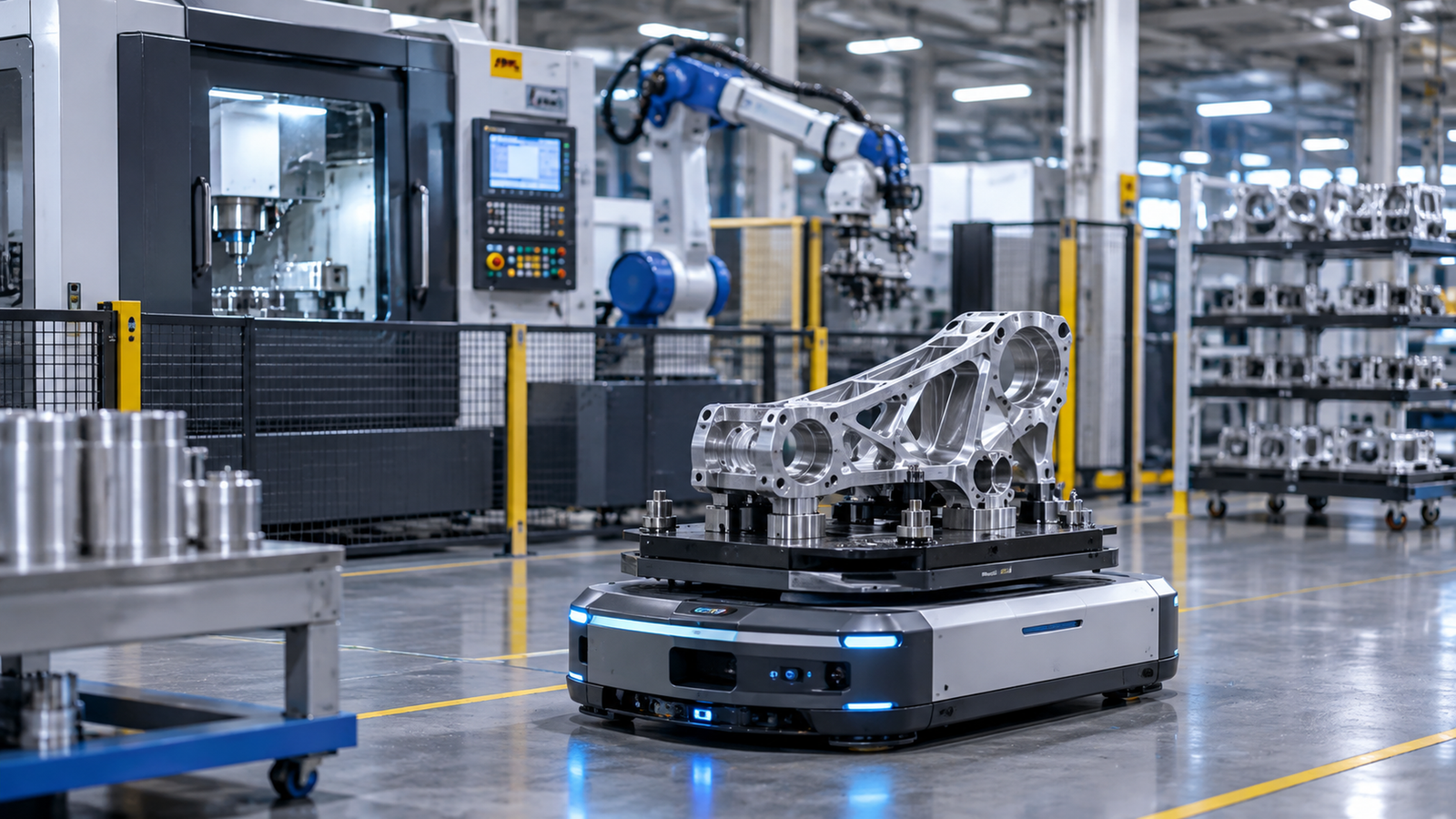
Autonomous Material Handling for Aerospace Machining
The visual shows an autonomous mobile robot carrying a precision-machined aerospace component through a CNC manufacturing environment, with a robotic machine-tending cell in the background. It illustrates the role of mobile material handling in moving high-value workpieces between production operations while respecting defined routes and handover points. The key takeaway is that autonomous transport must be coordinated with machine status, part identity, payload constraints, and downstream inspection needs.
Fleet coordination
Coordinating Robots, Drones and Vehicle Fleets
Mixed fleets create coordination problems that do not arise when each platform is planned independently. A drone may need a clear inspection zone while an AMR passes below. A mobile robot may approach a machine cell as a fixed manipulator completes a cycle. A manual forklift may temporarily block a route used by multiple autonomous vehicles. Research should define shared maps, right-of-way rules, geofenced areas, task priorities, communication responsibilities, and the procedure for resolving conflicting plans.
A distributed architecture may place immediate collision avoidance and motion constraints on each platform while coordinating task assignments and facility-level priorities through a fleet manager. The system should not depend on a remote service for time-critical safety functions. If the fleet manager becomes unavailable, each platform needs a defined local behavior, such as stopping in a safe location, completing a permitted low-risk action, or returning to a designated recovery point.
Coordination data may include robot identity, pose and localization quality, task state, payload status, battery state, route reservations, machine availability, work order priority, and exception codes. The research must specify update frequency, data ownership, clock behavior, message expiry, and how the system handles stale or contradictory information.
Evaluation
Demonstration Design and Comparison Methods
A demonstration should select one platform and one bounded task relevant to the facility. Examples include AMR transfer of a fixture-mounted machined part, robotic machine tending within a guarded cell, or drone-based visual survey of a defined inspection area. The test plan should identify the platform configuration, payload, route or work envelope, sensors, control interfaces, operating restrictions, human roles, and independent method for confirming task outcome.
Compare a simple fixed policy with a candidate adaptive policy under the same task conditions. For example, a fixed route and first-available vehicle assignment can be compared with a policy that accounts for route congestion, battery state, machine readiness, and changing task priority. In simulation, test repeatable scenarios and edge cases. Where suitable, follow with a controlled physical demonstration in an isolated or approved operating area.
Navigation and task execution results must be reported separately from inspection quality. A drone can complete a route without producing usable inspection evidence. An AMR can reach a station without confirming that the correct part was delivered in the required orientation. Metrics should reflect the actual purpose of the task.
Implementation
Data, Platforms and Integration Requirements
Research may require robot telemetry, localization and map data, task and fleet logs, machine status, production schedules, payload and fixture records, inspection plans, camera or depth data, and operator intervention records. Data should be time-aligned and associated with the relevant platform, task, asset, and operating condition. Sensitive production information and controlled aerospace technical data require appropriate access and retention controls.
Candidate platforms include industrial AMRs and AGVs, collaborative and fixed industrial robots, machine-tending manipulators, inspection drones, fleet-management software, edge computers, safety-rated sensors and controllers, industrial networks, and manufacturing execution system (MES) interfaces. Integration with CNC controllers, warehouse management systems (WMS), quality management systems (QMS), and production scheduling tools depends on the target facility and must be verified.
The interface specification should define task requests, acknowledgements, status transitions, cancellation behavior, exception reporting, and the authority to issue commands. Physical action must remain within the platform’s approved operating envelope. Machine interlocks, emergency stops, protective devices, restricted zones, and personnel safety procedures cannot be bypassed by a fleet-management or AI application.
Safety and oversight
Safety, Human Authority and Operational Resilience
Autonomous operation in aerospace manufacturing requires a task-specific safety assessment. Payload shape, mass, sharp edges, fragile surfaces, overhead loads, aisle width, pedestrian access, machine openings, and interaction with forklifts or cranes can change the risk profile. Drone operations introduce additional concerns involving rotor hazards, overhead structures, battery handling, flight containment, and the possibility of dropped payloads.
Research should document who authorizes a task, who can pause or stop it, what conditions trigger a protective response, and how the platform returns to service after an interruption. The system should retain an event record for task requests, route changes, operator interventions, safety stops, handovers, and recovery actions. A successful restart must not be inferred solely from a communications reconnection.
AI-generated plans and learned policies should be bounded by explicit operating constraints and reviewed against representative failure conditions. Any physical demonstration should be conducted under the facility’s approved safety procedures and applicable standards. Research findings do not constitute a safety certification or approval for production use.
Evidence boundaries
Research Status, Assumptions and Limitations
This page describes a research direction and candidate evaluation methods. It does not claim that every robot, drone, autonomous vehicle, or fleet-coordination capability is active, suitable, implemented, certified, or deployed by Machentra. Each study should state its current status, platform, task, test conditions, baseline, data sources, limitations, and remaining validation work.
Simulation is useful for repeatable testing of route congestion, task allocation, localization degradation, and coordination failures. Simulated results do not establish physical navigation accuracy, payload handling performance, safety, or inspection quality. Physical results should identify the actual platform, environment, sensor configuration, payload, control limits, and test procedure. Where results are synthetic or assumption-based, label them accordingly.
A deployment decision requires facility-specific engineering, integration, cybersecurity, safety, workforce, and maintenance review. The appropriate level of autonomy depends on the task and operating context. Human authorization and established quality procedures remain necessary wherever required by the process.
Illustrative image
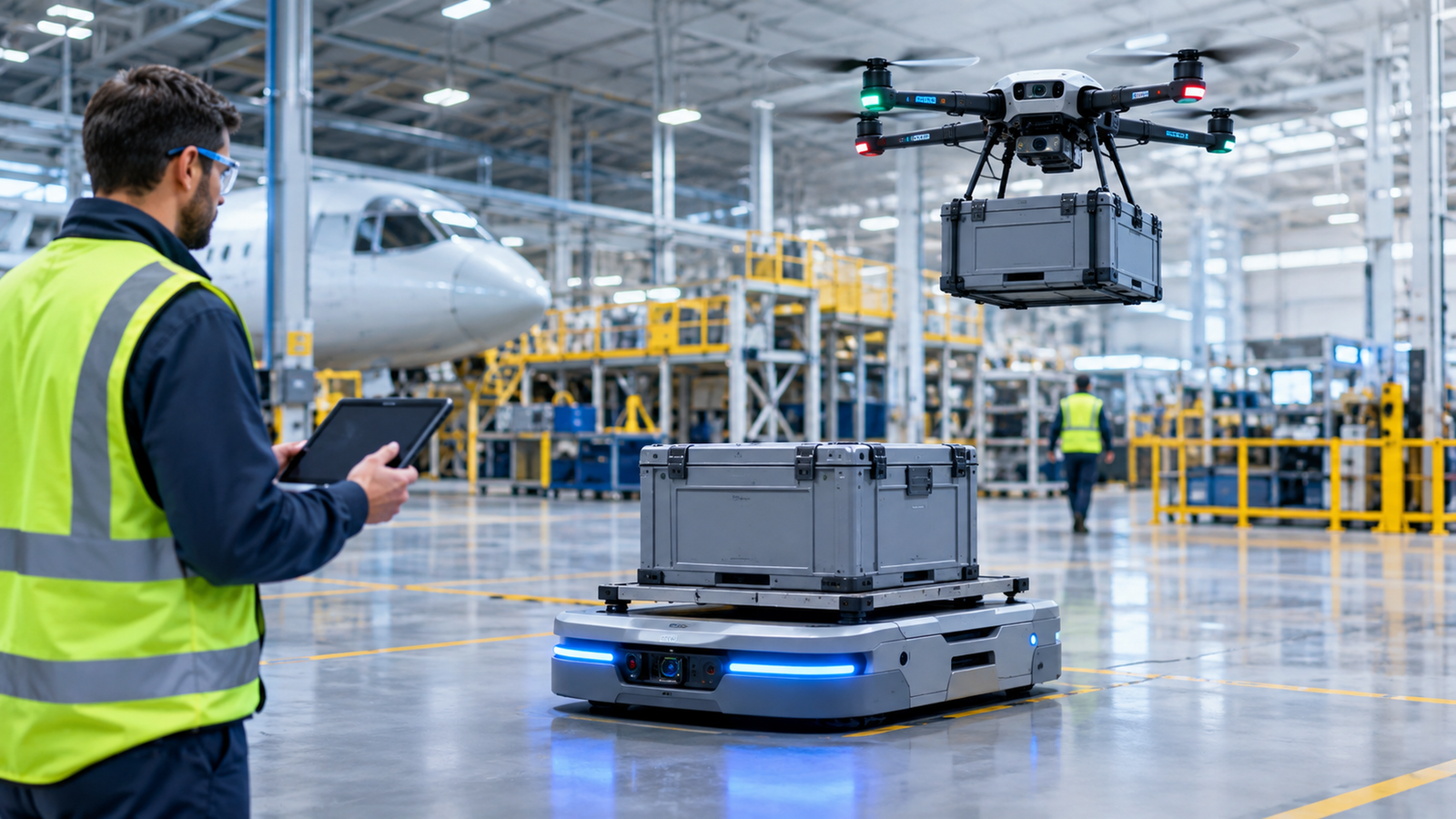
Coordinated Drone and AGV Logistics for Aerospace Facilities
The visual depicts an industrial drone and an autonomous ground vehicle operating in an aerospace warehouse while a technician supervises the activity. It represents a mixed-fleet logistics concept in which aerial and ground platforms may support different tasks under shared facility rules. The key takeaway is that coordination, payload control, human oversight, and safe operating boundaries are essential when multiple autonomous platforms share an industrial environment.
Provides access to the broader research program directory.
Collaborate
Discuss a Robotics or Autonomous Logistics Research Question
A useful research discussion starts with a specific manufacturing or logistics task, the component or material being handled, the operating area, the equipment and platforms involved, and the conditions that make the task difficult. It should also identify the current process, the required level of human oversight, the available data and interfaces, and the evidence needed to judge success.
Machentra welcomes technical discussions with aerospace and defense manufacturers, precision machining and composites specialists, automation teams, and research organizations evaluating robotics, drone inspection, autonomous vehicles, or distributed industrial intelligence.