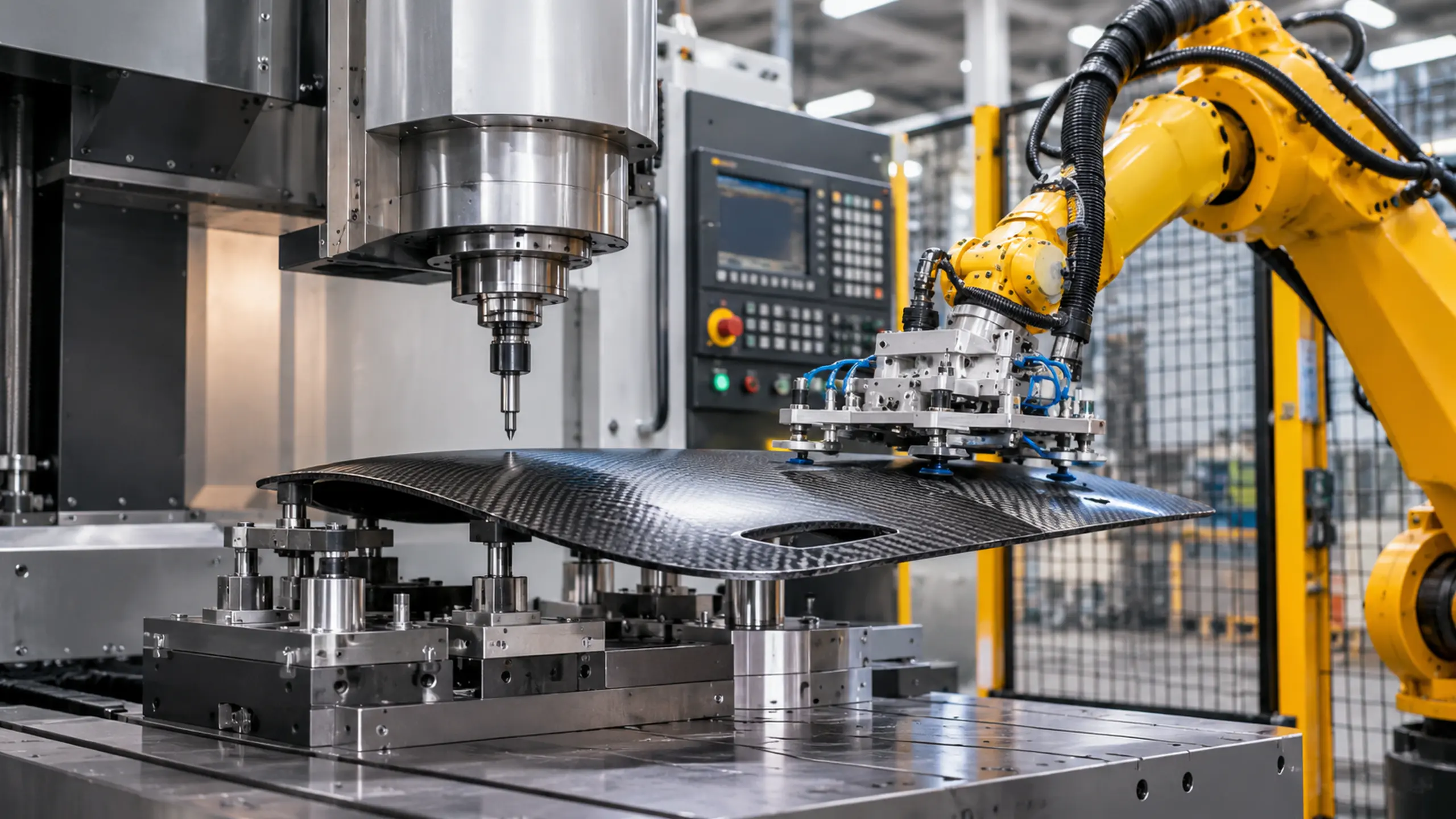
Physical Action and Control Technologies for Precision Machining & Composites
How can AI-supported decisions connect to machining and composite-production equipment without bypassing validated controls or operator authority? Explore the controllers, actuators, robotics, and equipment interfaces involved in authorized physical actions.
Image: AI-generated illustrative artwork, not licensed stock photography or a verified Machentra installation. The machine process remains subject to its validated program, tooling, and protective controls.
Overview
Physical Action in Machining and Composite Production
Physical action technologies connect a digital decision with a change in the production environment. In precision machining and composites, that may involve positioning a workpiece, transferring a component, adjusting a permitted machine setting, initiating a supervised sequence, or coordinating a robotic inspection or handling task. The right approach depends on the machine, process, tooling, material, and control boundary.
Machentra’s Physical AI and Artificial Intelligence of Things (AIoT) approach can be evaluated as a path from equipment and process observations to a decision, an authorized command, and confirmation of the resulting physical state. Technology selection and integration should be treated as workflow-specific until interfaces and capabilities have been validated.
Evaluation path
Observation
Equipment and process observations
Decision
An AI-supported decision
Authorized command
A command sent through an approved path
Confirmation
Confirmation of the resulting physical state
Equipment roles
Controllers, Drives, Actuators, and Robotic Systems
Programmable logic controllers (PLCs), CNC controllers, motion controllers, servo drives, motors, pneumatic or hydraulic actuators, grippers, and robotic systems perform different roles.
Controllers
Execute defined logic. This includes PLCs, CNC controllers, and motion controllers.
Drives
Regulate motion, as servo drives do.
Actuators
Produce movement, including through motors, pneumatic or hydraulic actuators, and grippers.
Robotic Systems
Carry out programmed paths or handling sequences.
A system design must identify which component owns each command and state, and which functions remain independent of AI software.
Relevant machining and composite workflows may include the following. These tasks require attention to the workpiece and handling conditions listed alongside.
A candidate action should have a defined target and permitted operating envelope.
Control boundary
Supervisory Commands and Machine Control Loops
AI-supported software is best separated from low-level control loops that maintain motion, speed, torque, position, or other equipment variables.
01 / SUPERVISORY LAYER
Proposes and Requests
A supervisory layer may propose a task, request a validated sequence, or send a bounded setpoint through an approved interface.
02 / MACHINE CONTROLLER
Retains Control
The machine controller and its engineered protections must retain responsibility for the control functions assigned to them.
03 / AI RECOMMENDATIONS
Not a Substitute
AI recommendations should not be treated as a substitute for validated CNC logic, robot programming, safety-rated control, or process qualification.
Interfaces may expose commands, status codes, interlock states, setpoints, alarms, and acknowledgments. Implementation depends on the equipment manufacturer, controller configuration, available protocol or API, permissions, timing requirements, and the condition of existing integration infrastructure. Compatibility must be checked against the actual device and configuration rather than assumed from a protocol name.
Authority and safeguards
Authorization, Interlocks, and Manual Control
Every action path should establish the target and confirm the request before a command is issued. Interlocks, guarding, emergency stops, and independent protective functions must remain in their intended roles. Define who can approve actions, which actions require operator confirmation, and how manual control is restored.
Establish the target: identify the target equipment and workpiece.
Confirm permission: confirm that the request is permitted.
Check conditions: check the required operating conditions.
Record the exchange: record the command and response.
Plan for Exceptions
Plan for the following conditions. A timeout should not be interpreted as proof that an action did not occur. Recovery procedures should reconcile controller status and the observed physical state before a task is retried or closed.
Rejected commands
Unexpected machine states
Sensor disagreement
Stale data
Duplicated requests
Communication loss
Incomplete execution
<!--
SECOND VISUAL (uncomment after uploading the image to the media library and replacing the URL):
Operator Supervision of Robotic Machining Control. A human-supervised robotic work area where an operator uses a pendant while a robot is positioned near a precision aerospace component, emphasizing operator authority, manual control, and clear equipment-state feedback. AI-generated illustrative artwork, not a photograph of Machentra personnel or a customer installation.
-->
Outcome verification
Verification of Physical Outcomes
Command dispatch and acknowledgment are not the same as verified execution.
Confirm the outcome using an independent or suitably separate observation, such as position feedback, a sensor reading, a machine-state record, a vision check, or an operator confirmation appropriate to the task.
For machining and composite operations, outcome checks may include fixture occupancy, part presence, transfer completion, robot position, a machine’s reported state, or confirmation that a supervised sequence reached its expected endpoint. The verification method must be selected for the physical task and its failure modes.
Linked records
Decision
Authorization
Command
Acknowledgment
Outcome
Keep the decision, authorization, command, acknowledgment, and outcome records linked by identifiers and timestamps.
Evaluation and commissioning
Integration and Commissioning Considerations
A practical evaluation begins with a bounded workflow and a documented baseline. Test normal operation and exception cases in a controlled environment before considering production use.
Results should be reported only after the tests have been executed and reviewed.
Technology stack
Where Physical Control Fits in Machentra’s Technology Stack
Machentra’s Physical AI Action Engine™ represents the functional role of connecting approved decisions with execution pathways.
AIoT Layer
Collects machine and sensor data, preserves event context, and makes equipment state available to software.
Physical AI
Adds an action pathway where the equipment, interfaces, authority, and verification requirements are defined.
Physical AI Action Engine™
Connects approved decisions with execution pathways.
The architecture is a design framework; supported devices, tested integrations, and deployment readiness must be confirmed for each application.
Further information
Explore Related Technologies
Start with your operating context
Review a Machine or Handling Workflow
Review a specific machine or handling workflow with Machentra to define the equipment, control boundary, authorization path, and outcome verification the application requires.