Research for Physical AI and AIoT in Precision Machining & Composites
Aerospace and defense manufacturers depend on repeatable machining, controlled composite processes, reliable inspection, and traceable production records. Yet important operating conditions can remain difficult to observe in real time: tool wear develops between inspections, thermal effects influence dimensional results, machine and fixture conditions change, and composite process deviations may require careful interpretation before a part can proceed.
Practical Research Grounded in Specific Assets and Evidence
Machentra examines how artificial intelligence (AI), Physical AI, and Artificial Intelligence of Things (AIoT) can connect identification, sensing, analysis, and authorized action across these production environments. The research focus is practical: define the manufacturing problem, identify the evidence needed to understand it, evaluate candidate methods against meaningful baselines, and establish what must be verified before an approach is used in production.
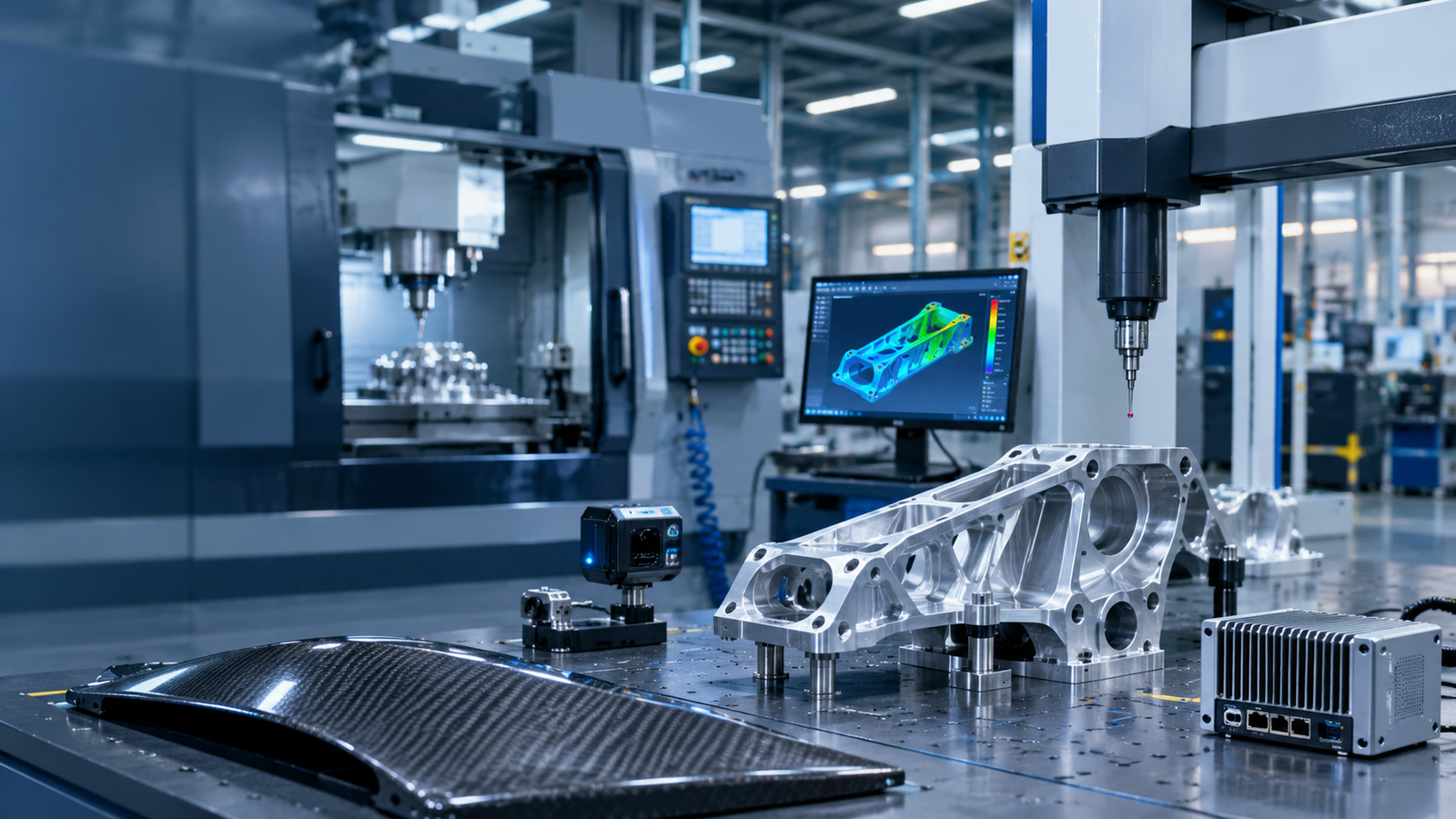
This research agenda is specific to precision-machined aerospace components and composite structures. It addresses CNC machine tools, spindles, cutting tools, fixtures, workholding, in-process probing, coordinate measuring machines (CMMs), surface inspection, composite layup and cure equipment, and approved non-destructive testing (NDT) workflows. It does not assume that a method validated for one asset, material, process, or facility will transfer unchanged to another.
Research priorities
Research Priorities for Aerospace Machining and Composites
Several recurring engineering challenges make this sub-industry distinct. Precision machining research must account for tight dimensional and geometric tolerances, material-specific cutting behavior, tool and spindle condition, thermal drift, chatter, coolant and chip conditions, and the relationship between process settings and measured part quality. Composite manufacturing adds material- and process-specific variables such as ply placement, fiber orientation, vacuum integrity, pressure, temperature, cure progression, bond-line condition, and inspection indications.
Research can help teams determine which signals are useful, how to associate them with the correct part and process history, when an AI-supported result is reliable enough to inform a decision, and how an approved response can be checked. Relevant users include CNC process engineers, manufacturing engineers, maintenance and reliability teams, composite process engineers, quality engineers, dimensional inspectors, NDT personnel, production supervisors, and operational technology (OT) and information technology (IT) teams.
01
Machine and Tool Health
Investigate vibration, acoustic, spindle-load, temperature, and cutting-process signals for tool wear, chatter, abnormal loading, and maintenance prioritization.
02
Dimensional and Surface Quality
Connect in-process probing, CMM results, optical inspection, surface profiles, drawing revisions, datum schemes, and geometric dimensioning and tolerancing (GD&T) requirements.
03
Composite Process Visibility
Study how temperature, pressure, vacuum, time, material identity, layup records, and approved NDT observations can support process review and traceability.
04
Part and Process Genealogy
Associate serialized parts and material lots with machine, fixture, tool, NC program revision, setup, process events, inspection results, and authorized dispositions.
05
Controlled Operational Response
Evaluate bounded recommendations or approved equipment adjustments with explicit authority, interlocks, human review, and independent confirmation of the physical outcome.
Program directory
Explore the Research Programs
The program directory organizes research questions by the functions needed to connect physical production with trustworthy decisions and verified outcomes.
Study how part identity, material and tool records, machine signals, metrology, and process observations can be associated to estimate the current state of a machining or composite workflow.
Examine how AI recommendations can be evaluated, bounded, authorized, and connected to equipment interfaces without bypassing machine protections or quality authority.
Explore process models, machine and production simulations, scenario coverage, hardware-in-the-loop testing, and the limits of transferring simulated results to physical equipment.
Assess edge intelligence and coordinated robotic or autonomous systems for machine tending, workpiece transfer, inspection support, and movement of materials within controlled manufacturing facilities.
Study how to verify system behavior, preserve human authority, manage communication constraints, and confirm that an instruction produced the intended physical result.
Explore how process knowledge, engineering documents, maintenance history, inspection records, and operator expertise can support governed AI learning and practical deployment.
Research is organized around the functional relationship between identifying an asset or part, sensing its physical condition, interpreting evidence, and deciding whether an action is appropriate. The AIoT configuration emphasizes identification, sensing, data handling, and decision support. The Physical AI configuration extends that chain to an authorized physical response and feedback from the equipment or process.
CNC machining cell
Identification may associate a workpiece with its serial number, material lot, fixture, tool, and NC program revision. Sensing may capture spindle vibration, load, temperature, in-process measurements, or inspection data. Decision functions may flag an unusual condition, estimate a maintenance priority, or recommend a quality review. If physical action is in scope, an approved control path must define the target, limits, permissions, interlocks, operator role, and recovery behavior.
Composite manufacturing
The same functional pattern must be adapted to material identity, layup and cure records, process measurements, inspection evidence, and the authority required for process or quality decisions.
These examples describe research and system-design questions; they are not claims that every function is currently implemented or deployed by Machentra.
Each research program should begin with a bounded industrial problem and a defined decision or workflow. A useful study identifies the assets and process steps in scope, the intended users, available data sources, interfaces, operating conditions, baseline method, candidate approach, and constraints. It should also state whether the work is a proposal, an illustrative scenario, an executed simulation, a controlled bench or hardware test, a customer pilot, or an operational result.
Candidate methods may include sensor fusion, time-series analysis, machine vision, anomaly detection, predictive models, optimization, digital twins, edge inference, robotics, and rules-based controls. Method selection depends on the question and evidence available. A named sensor, protocol, controller, or software interface is an implementation option until compatibility and performance have been verified for the intended environment.
Demonstrations should use representative machining or composite workflows and document assumptions, data provenance, asset context, model and software versions, test conditions, and failure cases. Synthetic data can help explore scenarios but must be labeled as synthetic; it does not establish performance on production equipment. Where physical observations are available, compare predictions with held-out measurements and a suitable baseline. Where they are not available, label the model as assumption-based and leave physical validation pending.
Responsible use
Evidence, Status, and Responsible Use
Explicit research status
Research status must be explicit. Shared research from a broader program is not automatically company-specific development. A proposed investigation is not an implemented capability; a demonstration is not a customer deployment; and a simulation result is not proof of production performance.
Published findings should identify the method, test conditions, assumptions, evaluation data, limitations, and remaining validation work.
Decision aids, not replacements
AI-supported inspection and process recommendations should remain decision aids unless a defined method has been validated and approved for that use. They do not replace engineering drawings, customer specifications, qualified inspection procedures, calibrated instruments, required personnel qualifications, machine safety systems, or authorized product-release decisions.
Physical control requires a separate assessment of equipment interfaces, operating limits, safety functions, human authority, and outcome verification.
Research outputs should preserve reproducibility where applicable, including datasets or data descriptions, preprocessing steps, code and parameter versions, random seeds for simulations, model versions, test configurations, validation results, and known limitations. Sensitive production data, controlled technical information, and proprietary manufacturing records require appropriate access, retention, and disclosure controls.
Collaborate
Collaborate on a Research Question
Machentra welcomes technical discussions with aerospace and defense manufacturers, precision machining and composites specialists, engineering teams, system integrators, and research organizations working on relevant industrial problems. A useful starting point is a specific asset or process, the operational decision that needs support, the data and interfaces available, and the evidence required to judge success.
To discuss a research question, describe the manufacturing workflow, the equipment or material involved, the current inspection or operating method, and the constraints that a study would need to respect.