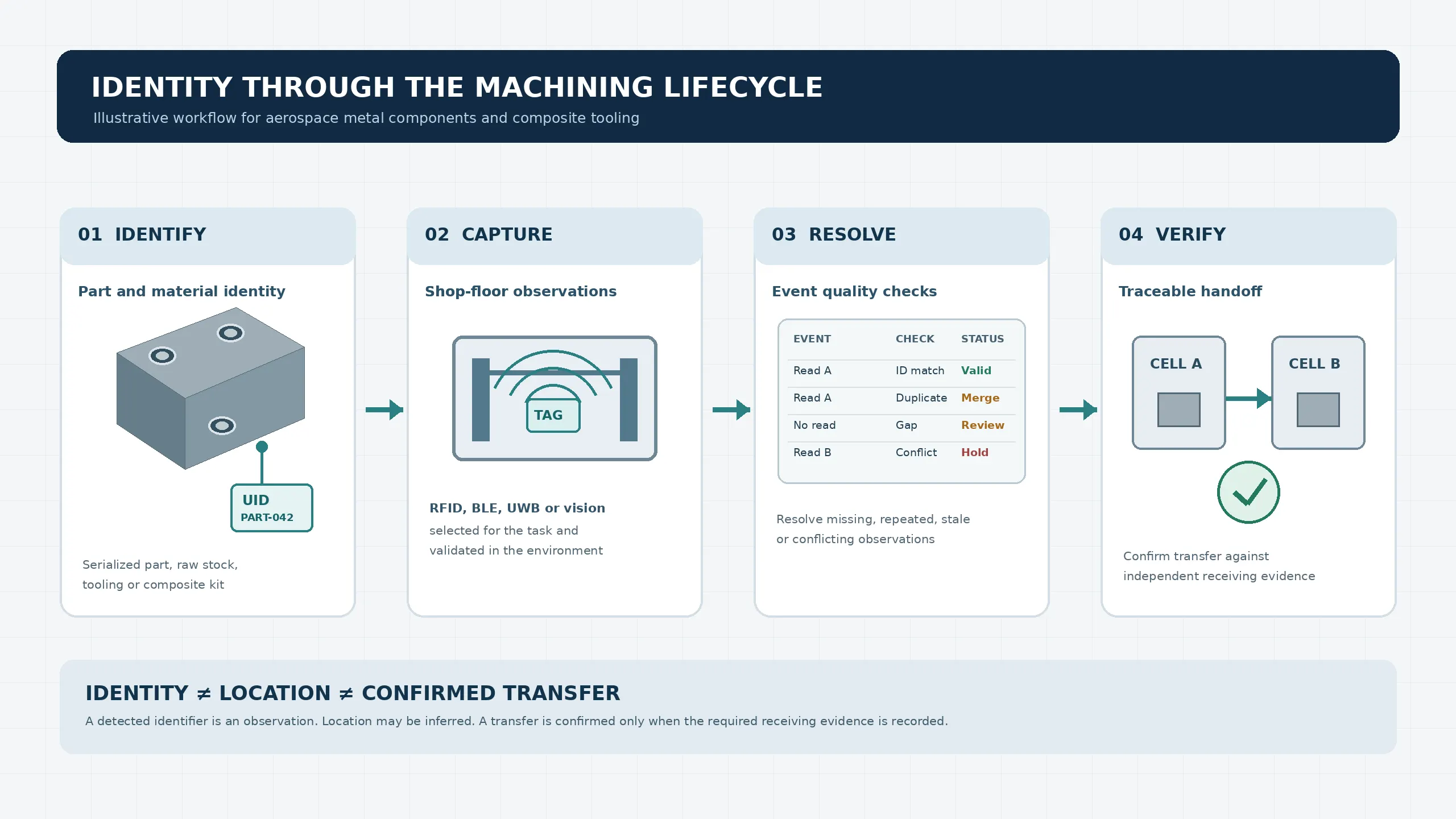
The Identification Engine for Precision Machining & Composites
The Machentra Identification Engine is the identity layer for physical assets and production events in precision machining and composites manufacturing. It is intended to associate the correct identity with machined components, raw material, composite kits, tooling, fixtures, work in progress, and selected production equipment as those items move through receiving, preparation, machining, inspection, finishing, storage, and shipment.
In aerospace and defense supply chains, traceability is more than knowing where an item was last seen. A useful record connects a physical item to its part number or material designation, revision, lot or serial identifier, process context, responsible operation, and relevant quality or custody event. Identification data can then provide context for inspection records, equipment measurements, production decisions, and downstream enterprise systems.
The engine is designed to help organize those identity and event relationships. The identification method, location model, and level of confirmation must be selected for each workflow and validated in the actual facility. RFID, Bluetooth Low Energy (BLE), Ultra-Wideband (UWB), and machine vision are implementation options, not universal solutions or claims of prevalidated compatibility.
What the Identification Engine identifies
The identification model starts with the entities that matter to a defined production process. Depending on the facility and product, these may include:
- Aerospace components: serialized housings, brackets, structural fittings, machined panels, and other controlled parts.
- Raw material and composite inputs: metal stock, plate, billet, prepreg rolls, composite kits, bonded subassemblies, and material lots where the workflow requires identity continuity.
- Production resources: cutting tools, tool holders, fixtures, jigs, molds, layup tools, inspection fixtures, and selected machine assets.
- Work in progress: parts or material awaiting machining, deburring, surface treatment, inspection, rework, or final release.
- Handling units: trays, carts, racks, containers, and packaging used to move parts or materials between defined work areas.
Each entity should have a stable internal key and the appropriate source identifiers. These may include a part number, revision, serial number, lot number, material batch, tool ID, or handling-unit ID. The model should preserve relationships such as a component's material lot, its parent assembly, the tooling used in a process, or the container carrying multiple items. These relationships should be based on approved manufacturing records rather than inferred from proximity alone.
Identity, location, and lifecycle events
Identity and location answer different questions. An identifier read can establish that a tag or visual code was observed. A location system may estimate that an item is within a defined zone or near a reader, anchor, camera, or workstation. Neither observation automatically proves that a part was transferred, accepted, inspected, or released.
A practical lifecycle model can represent events such as receiving, kitting, issue to a work center, machine setup, operation completion, inspection queue entry, inspection disposition, rework, storage, and shipment. The event record should identify the entity, event type, event time, observation time, source device or user, source and destination zones where applicable, and a quality or confidence status. Add process-specific fields only when the workflow needs them.
For aerospace work, identity records may need to preserve the relationship between a serialized part and its drawing revision, material lot, router or traveler, inspection status, and approved disposition. For composite work, the relevant chain may include material batch or roll, kit identity, storage or out-time records where required by the approved process, layup or mold association, and the resulting part or subassembly. The exact data set depends on the organization’s quality system and governing procedures.
Identification technology roles
No single identification technology is appropriate for every asset, environment, or event. Selection should begin with the question the workflow must answer: identify an item at a controlled point, detect its presence in a zone, estimate its position, or verify a transfer. The physical environment, line of sight, material, mounting surface, read distance, update frequency, power, and maintenance access all affect the design.
Radio-frequency identification (RFID)
RFID can support item identification at receiving points, tool cribs, controlled storage areas, kitting stations, or defined production handoffs. Passive tags may be suitable where the workflow calls for an identifier read at a known checkpoint. Active RFID may be considered where powered tags and broader detection coverage are justified. Metal surfaces, liquids, tag orientation, shielding, reader placement, and nearby equipment can affect read performance. A facility test should verify the actual tag, antenna, reader, mounting method, and part geometry.
Bluetooth Low Energy (BLE)
BLE beacons and receivers may support zone-level presence or location use cases for mobile carts, containers, tooling, or selected equipment. The result depends on beacon placement, receiver density, radio conditions, obstruction, interference, and the location method. BLE presence should not be represented as precise part-level positioning unless the configured system has been tested to meet that requirement.
Ultra-Wideband (UWB)
UWB can be evaluated when a workflow requires more granular real-time location information than a simple checkpoint or zone event. Anchor geometry, line of sight, multipath reflections, installation tolerances, calibration, and the physical layout influence results. UWB is not automatically required for component traceability; it is relevant when the location question and the cost and installation effort justify it.
Machine vision and code-based identification
Cameras can read suitable barcodes, QR codes, labels, or direct part markings when the identifier is visible and image quality is sufficient. Vision can also help associate an observed item with a known shape or feature set, but visual recognition should not replace a controlled serial or lot record unless the identification method has been validated for the required part family. Surface finish, glare, coolant, chips, occlusion, marking contrast, camera angle, lighting, and part variation must be considered.
These technologies may be combined. For example, a barcode or direct part marking can establish identity at a workstation, while RFID may record passage through a controlled storage checkpoint. A BLE or UWB system may provide zone or location context for a mobile fixture or cart. The combination should be driven by required events and test evidence, not by the number of technologies deployed.
A practical identity and traceability workflow
Consider a serialized aluminum aerospace bracket moving from a machining cell to dimensional inspection and then to a controlled storage area. At the machining cell, an operator or validated reader associates the part identifier with the completed operation and the relevant traveler or production record. At inspection, a second observation associates the same identifier with the inspection record and disposition. At storage, a checkpoint observation records the item entering the designated zone.
The event processor checks whether each observation refers to a known identifier, whether the event sequence is plausible, and whether the required preceding event exists. A missed read creates a traceability gap rather than an assumed transfer. A repeated read is evaluated as a possible duplicate rather than counted automatically as a second movement. A conflicting identifier association is held for review so that a nearby tag, adjacent part, or incorrect visual match does not silently attach an event to the wrong component.
A transfer should be treated as confirmed only when the required receiving evidence is present. Depending on the process, that may be a second checkpoint read, an operator confirmation, a validated scan at the destination, or a reconciled receiving transaction. A reader acknowledgment alone does not prove that the intended part reached the destination.
Event quality and exception handling
Identification records are only useful when their limitations remain visible. The engine's event model should retain source and timing information so that downstream applications can distinguish a current observation from a delayed or uncertain one. At minimum, the workflow should account for:
- Missed observations: a required checkpoint has no valid event. The system should flag the gap and leave the transfer or process step unresolved until reviewed.
- Duplicate observations: the same identifier is read repeatedly within a defined event window. Deduplication rules should consider source, time, zone, and workflow rather than deleting records indiscriminately.
- Stale observations: an event arrives too late to represent the current state. Preserve event time and ingestion time so consumers can apply freshness rules.
- Conflicting associations: one observation appears to match multiple entities, or an identifier is associated with an incompatible part or process record. Hold the event for reconciliation.
- Out-of-sequence events: an item appears to reach a downstream operation before the required prior event is recorded. Flag the sequence for review rather than silently repairing the history.
- Connectivity interruptions: readers or edge devices buffer events during an outage. On recovery, process delayed records using their original event times and preserve the ingestion history.
Exception handling should identify who is responsible for review, what evidence is needed to resolve the issue, and how the corrected record is audited. A correction should not erase the original observation or conceal uncertainty.
Outputs for sensing, decisions, and traceability
Once identity and event quality are established, the resulting records can provide context to other functions in the Machentra Physical AI and Artificial Intelligence of Things (AIoT) architecture. The Sensing Engine can associate measurements with the correct machine, tool, part, or process context. The AI Decision Engine can use identity, event history, and quality flags when supporting exception review, inspection prioritization, or workflow decisions. Where an authorized physical response is in scope, the Physical AI Action Engine requires its own permissions, control interfaces, operating limits, and outcome verification.
Identification does not itself measure machine condition, determine product conformity, release a part, or control equipment. It supplies identity and event context that other systems may use. Downstream applications should receive the source identifier, event and ingestion times, observation method, location or zone context, quality flag, and the relationship to the relevant production or quality record.
Integration may involve manufacturing execution system (MES), enterprise resource planning (ERP), warehouse management system (WMS), quality management system (QMS), or computerized maintenance management system (CMMS) records. The actual interfaces, data ownership, supported protocols, and connector availability must be confirmed during requirements assessment. Do not assume that a named system or device is already integrated.
Two precision manufacturing workflows
1. Serialized machined component traceability
A machined aerospace component can be followed across material issue, work-center processing, inspection, rework where applicable, and final storage or shipment. The identity record links the component's serial number to the applicable part number and revision, material lot, traveler, operation history, and inspection disposition. A scan or validated marking read at each required handoff creates an event. If an event is missing, duplicated, stale, or inconsistent with the expected route, the record is flagged for reconciliation.
Useful evaluation measures include required-event completeness, incorrect identity associations, duplicate-event rate, unresolved transfer count, event latency, reconciliation time, and operator effort. Define the denominator and observation window before measuring performance. Do not publish a universal accuracy figure; results depend on the selected marking or tag, reader placement, workflow, and operating conditions.
2. Tooling and fixture location and custody
A tool crib or production area may need to identify and locate fixtures, jigs, molds, tool holders, or inspection equipment. A controlled scan can record issue and return events, while BLE or UWB may be evaluated if zone or position information is needed between those checkpoints. The identity record can associate the tool with its owner or responsible area, calibration or maintenance record where applicable, and the job or work center using it.
Useful evaluation measures include tool issue and return event completeness, time spent searching, unresolved custody events, incorrect tool-to-job associations, battery or device maintenance effort, and the proportion of location observations that meet the required zone or position definition. Personnel tracking is a separate, purpose-specific use case and should be addressed with appropriate access, retention, notice, and privacy controls.
How to evaluate an identification deployment
A pilot should begin with one defined asset class and a bounded route or set of checkpoints. Record the baseline process, expected events, operating shifts, quantities, physical layout, user roles, source systems, and exception procedures. Test representative parts, materials, fixtures, and containers under actual conditions, including metal surfaces, composite materials, machine enclosures, racks, coolant, handling, and realistic radio or camera interference.
- Identity association: percentage of observed events correctly associated with the intended entity, with false associations reported separately.
- Event completeness: correctly captured required events divided by all required ground-truth events in the test scope.
- Duplicate-event rate: duplicate records after the documented deduplication policy, reported against the defined event population.
- Transfer confirmation: percentage of required transfers supported by the specified receiving evidence.
- Latency and freshness: elapsed time between the physical event and its availability to the consuming application, including delayed delivery.
- Exception workload: number and type of events requiring manual reconciliation, plus time and effort to resolve them.
- Operational fit: installation effort, device maintenance, read or scan ergonomics, network availability, data ownership, and integration effort.
Compare the candidate workflow with the existing process under matched operating conditions. Keep test labels, known identities, and ground-truth movement records separate from the observations supplied to the system. Include missed reads, duplicate reads, incorrect associations, damaged or obscured labels, network interruptions, and out-of-sequence events. Report limitations and adverse cases alongside successful observations.
A successful pilot demonstrates performance only within its stated scope. It does not establish that the same configuration will work across every part family, facility, machine enclosure, composite material, or production route.
Discuss your identification workflow
Start with the part, material, tooling, or work-in-progress item that is most difficult to identify or reconcile today. Machentra can use the workflow, required events, operating environment, available records, and integration constraints to frame an identification assessment and define what a pilot should verify.