Predictive Maintenance for Precision Machining & Composites
Use equipment condition, operating history and maintenance records to help determine what to inspect, when to schedule work and which assets deserve attention first. Explore a practical approach to maintenance decision support for aerospace machining and composite production environments.
Discuss a Predictive Maintenance Evaluation Explore Equipment ApplicationsMake Better-Informed Maintenance Decisions
Predictive maintenance uses equipment condition, operating history and maintenance records to help teams decide what to inspect, when to schedule work and which assets deserve attention first.
In aerospace precision machining and composites production, those decisions must account for machine configuration, part requirements, process state, production schedules and the consequences of an unplanned interruption.
Machentra's Physical AI and Artificial Intelligence of Things (AIoT) approach can connect physical measurements with asset identity, operating context and AI-supported decision workflows. The value depends on the quality of the underlying evidence and whether maintenance teams can act on a finding within the available production window.
What Predictive Maintenance Means on an Aerospace Production Floor
Condition monitoring shows how an asset is behaving now or how its measurements are changing. Predictive maintenance goes a step further by using relevant history and validated methods to estimate maintenance risk or support a forward-looking intervention decision.
The distinction matters. An unusual vibration pattern may justify investigation, but it does not by itself establish a bearing fault, identify its cause or calculate the time remaining before failure.
Preventive Maintenance
Scheduled maintenance based on defined intervals, operating hours, cycles or approved maintenance requirements.
Condition-Based Inspection
Inspection or maintenance planning informed by measured equipment condition and observed changes.
Predictive Analysis
Use relevant history and evaluated analytical methods to support forward-looking maintenance decisions.
For related measurement strategy, see Condition Monitoring , covering sensor selection, measurement context and abnormal-condition review.
Equipment and Failure Modes to Consider
Predictive maintenance should begin with a defined asset group and a short list of consequential failure modes.
The same model should not be assumed to apply across different machine designs, process recipes, duty cycles or production environments.
CNC Machine Tools and Machining Cells
For machining centers, turning centers and other computer numerical control (CNC) equipment, a maintenance review may include:
Spindles and Bearings
Review vibration, temperature, speed, load and service history for spindle assemblies and bearings.
Axis Drives and Motion Systems
Review relevant current, following error, temperature, lubrication and alarm records for drives, ball screws, linear guides and servo systems.
Coolant and Filtration
Consider flow, pressure, temperature, concentration checks, pump condition and filter-service history.
Hydraulic and Pneumatic Systems
Review pressure stability, leakage observations, compressor or pump duty and maintenance events.
Tooling and Tool Holding
Associate tool-life records, breakage events, runout checks and process data with the machine and operation.
Auxiliary Equipment
Include chip conveyors, lubrication systems and supporting equipment whose failure can stop a machining cell.
Connect Machine Signals with Maintenance History
A CNC maintenance assessment can bring together representative signals from the spindle, bearings, drive system, coolant and lubrication equipment. These measurements become more useful when associated with the machine, operating mode and maintenance record.
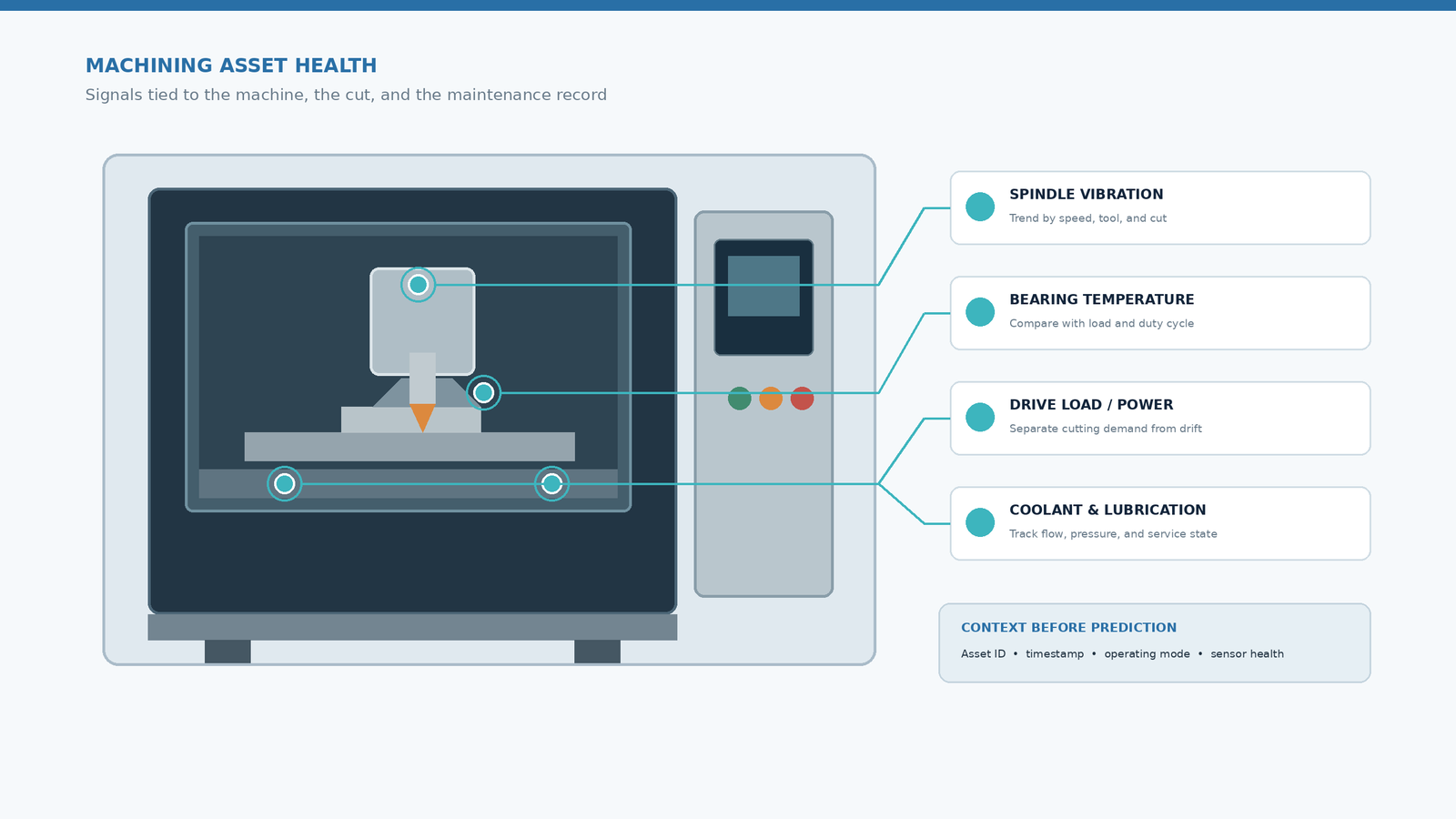
Signals to Associate with the Asset
- Spindle vibration and operating speed.
- Bearing temperature and relevant service history.
- Drive load, current or power information.
- Coolant and lubrication status.
- Machine alarms and operating events.
- Tool changes, inspections and component replacements.
This illustration is a conceptual equipment map. It does not represent a claim that Machentra has installed these sensors at a customer facility.
Assess Reliability Across Composite Production Equipment
Composite production relies on controlled equipment and process conditions. Maintenance planning may include autoclaves, ovens, vacuum pumps, chillers, thermal-fluid systems, vacuum manifolds, pressure systems and supporting utilities.
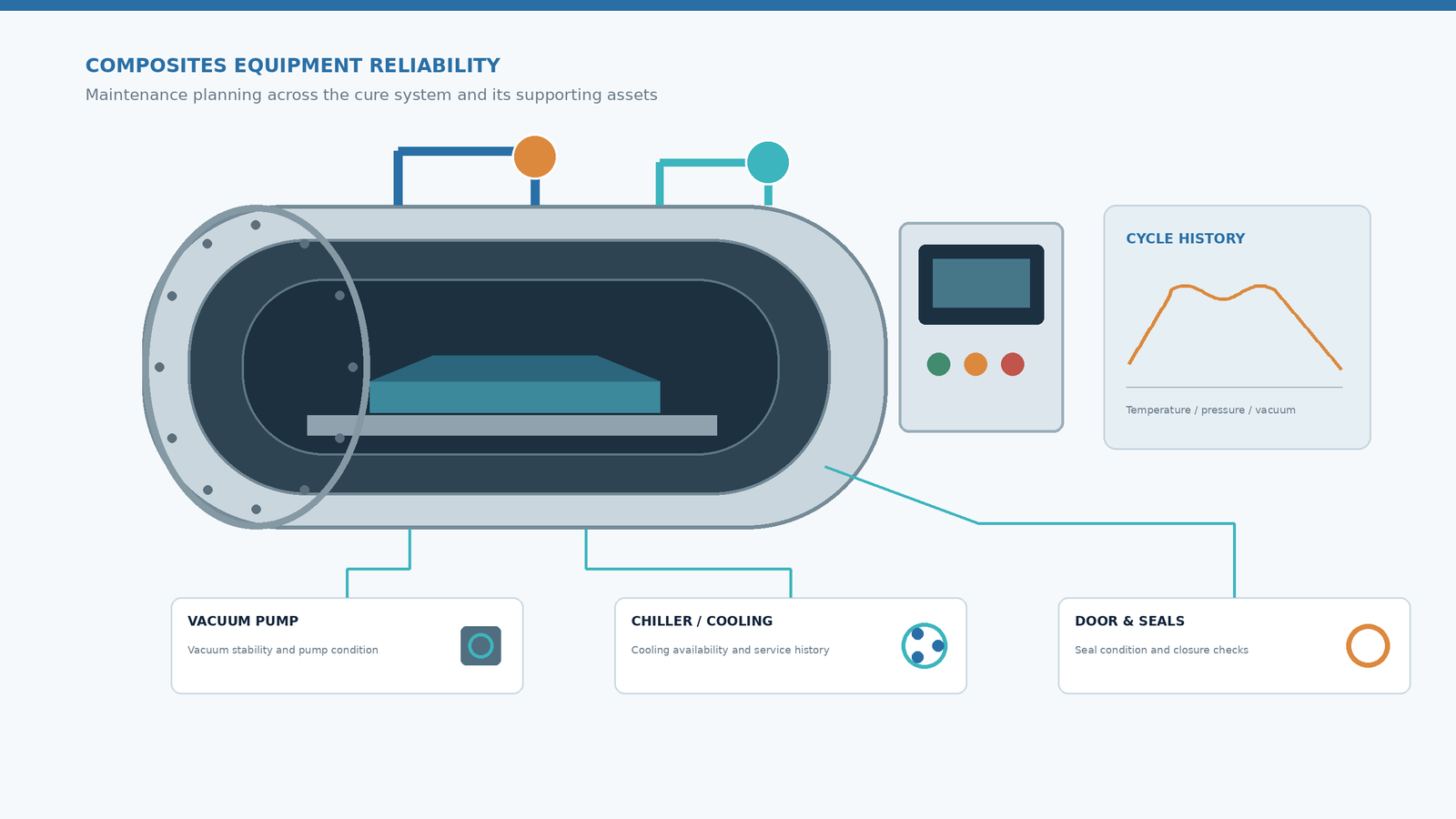
Equipment and Maintenance Records
Autoclaves
Temperature and pressure measurements, controller and sensor status, cycle history, alarm events and door or seal maintenance.
Vacuum Pumps
Vacuum stability, pump temperature, service intervals and evidence of leaks in connected lines or fittings.
Chillers and Cooling
Temperature trends, flow, pressure, alarms and maintenance records for cooling-system performance.
Heating and Circulation
Heating, circulation and control-system behavior, including instrument calibration status and documented deviations.
Vacuum and Pressure Systems
Review relevant operating records, stability, maintenance events and supporting equipment condition.
Equipment Availability
Consider equipment availability and cycle scheduling so maintenance can be planned around qualified production needs.
Data Needed for Credible Maintenance Decisions
A useful predictive maintenance dataset connects what the equipment experienced with what maintenance staff found and did.
Sensor readings alone are rarely enough. The data plan should identify the asset, define the operating context, preserve event timing and connect maintenance outcomes to the condition history that preceded them.
Asset and Configuration Records
Equipment ID, manufacturer and model where known, installed options, spindle or pump details, controller configuration, commissioning date and configuration changes.
Condition Records
Raw sensor readings and derived features, measurement units, sampling interval, calibration status, sensor location, quality flags and missing-data indicators.
Operating History
Run time, idle time, cycle count, spindle speed, load, feed conditions, program or process family, startup and shutdown events and operating modes.
Maintenance History
Work orders, inspection findings, replaced components, lubrication and calibration tasks, repair dates, labor time, failure codes and return-to-service checks.
Failure and Downtime Records
Event start and end, failure description, confirmed cause where established, production impact, repair action and planned or unplanned event status.
Production and Quality Context
Machine assignment, work-center schedule, part or process family where appropriate, hold status and relevant quality events, subject to access and data-governance rules.
Data Readiness Questions
- Can each measurement be associated with the correct machine, component and time period?
- Are machine operating modes and production conditions available to explain normal variation?
- Do maintenance records distinguish symptoms, suspected causes, confirmed causes and corrective actions?
- Are failure events and repairs recorded consistently enough to support time-based evaluation?
- Are there enough examples of the failure mode to test a predictive method without relying on a few isolated events?
- Can the team identify sensor outages, calibration changes, machine retrofits and changes in maintenance practice?
Choose the Right Analytical Method
Predictive maintenance is not one algorithm. The method should match the evidence available and the decision the maintenance team needs to make.
Anomaly Detection
Identifies observations or patterns that differ from an established baseline. It can be useful when confirmed failure examples are limited, provided normal operating variation is represented.
An anomaly is a reason to review the asset, not a diagnosis.
Failure-Risk Estimation
Uses historical examples and relevant operating information to estimate the likelihood of a defined event within a stated time horizon.
It requires consistent event definitions and representative examples.
Remaining Useful Life
Estimates the time or usage remaining before a defined maintenance endpoint. It requires detailed degradation history and reliable maintenance and replacement records.
Validation must represent the intended operating conditions.
Model evaluation should avoid information leakage. Data should be separated by time, asset or operating condition as appropriate, so that future information does not influence a prediction made for an earlier period.
The AI for Machining & Composite Operations page provides related context for Machentra's manufacturing intelligence approach.
Make the Maintenance Decision Workflow Visible and Auditable
A predictive maintenance workflow should make the path from observation to action visible and auditable.
Capture
Collect condition and operating data from the selected CNC machine, autoclave, vacuum pump, chiller or supporting asset.
Associate
Connect readings and events to the correct asset, component, timestamp, operating mode and sensor-health status.
Assess
Compare measurements with relevant baselines or apply a method whose inputs, limitations and evaluation results are documented.
Prioritize
Present the finding with severity, supporting evidence, uncertainty and operational context for the maintenance planner.
Review
Have a qualified maintenance or reliability professional decide whether to inspect, monitor, schedule service or take no action.
Create and Execute Work
Where systems and permissions allow, route an approved task into the CMMS or existing work-order process.
Verify
Record inspection findings, confirmed fault or no-fault outcomes, parts replaced, repair completion and post-maintenance condition.
Learn
Use reviewed outcomes to improve asset history, label quality and future evaluation.
In many maintenance settings, the appropriate output is a recommendation or work-order request for human approval.
Integrate with Maintenance and Production Systems
Predictive maintenance data should fit the systems that already manage equipment and production.
CMMS and EAM
Computerized maintenance management and enterprise asset management systems for asset registers, maintenance plans, work orders, inspection results and repair history.
MES
Manufacturing execution systems for work-center context, production schedules, cycle information and equipment state where available.
SCADA and PLC
Supervisory control and data acquisition or programmable logic controller systems for approved equipment signals and operational events.
ERP
Enterprise resource planning systems for approved asset, spare-parts, procurement and production information.
Define the Integration Requirements
- Asset identifiers and event timestamps.
- Measurement units and update frequency.
- Data ownership, access permissions and retention.
- Behavior during network or system outages.
- Data quality and missing-data handling.
- Compatibility with specific CNC controllers, CMMS, MES, PLC or autoclave systems.
A proposed interface is not the same as a tested connector. Compatibility with a specific system must be confirmed during technical discovery.
Processing may take place near equipment, on a customer-managed server or in a cloud environment, depending on latency, connectivity, security, data-residency and operational requirements.
See Machining Floor System Integration for related manufacturing integration context.
How to Evaluate a Predictive Maintenance Pilot
A pilot should test a specific maintenance decision on a defined equipment group. Begin with a credible baseline, such as the current preventive-maintenance schedule, existing alarm thresholds or documented inspection process.
Compare the candidate method against that baseline using matched operating periods or clearly defined test conditions.
Recommended Evaluation Measures
| Measure | What to Evaluate | Why It Matters |
|---|---|---|
| Useful Warning Time | Interval between a valid warning and a confirmed maintenance event, where timing is reliable. | Evaluates how early a useful warning is available. |
| Fault-Event Recall | Proportion of eligible, confirmed fault episodes identified within the defined evaluation window. | Reviews how many eligible events were identified. |
| False-Alert Rate | False alerts per operating hour, asset or another clearly stated denominator. | Measures unnecessary alerts relative to exposure. |
| Inspection Yield | Proportion of reviewed alerts leading to a relevant inspection finding or justified maintenance action. | Assesses whether alerts support useful follow-up. |
| Missed-Event Review | Confirmed events that were not flagged, including operating conditions and available data at the time. | Helps identify gaps and limitations in the method. |
| Maintenance Effort | Inspection hours, diagnostic effort, unplanned work and time spent reviewing alerts. | Evaluates the workload associated with the process. |
| Data Completeness and Quality | Missing readings, sensor outages, timestamp problems, asset-association errors and label coverage. | Measures the reliability of the underlying evidence. |
| Operational Impact | Planned versus unplanned downtime and production disruption, with assumptions and confounding factors stated. | Separates operational outcomes from model metrics. |
Earlier detection does not automatically mean downtime was avoided. The team must have had a feasible intervention, available parts and labor, and enough time to complete the work.
Any economic estimate should include installation, integration, software, maintenance, training and ongoing support costs.
When Is a Facility Ready to Start?
A facility does not need perfect data to begin a readiness assessment, but the first use case should be narrow enough to evaluate.
A practical starting point is one equipment family, one or two consequential failure modes and a maintenance team willing to review findings and record outcomes.
People and Ownership
An identified equipment owner and maintenance or reliability lead who can review findings.
Asset Information
An asset list with machine or equipment configuration and operating context.
Condition Data
Accessible condition records or a feasible plan for collecting suitable measurements.
Maintenance Records
Maintenance and downtime records with enough detail to define the target event.
Baseline and Measures
A documented baseline process and agreed pilot evaluation measures.
Governance and Approval
Approval for data access, system integration, cybersecurity review and any required equipment changes.
Related Resources
Build a Maintenance Evaluation Around Your Equipment
The most useful predictive maintenance program starts with a production constraint and a maintenance decision, not an algorithm selected in isolation.
Machentra can work with your team to define the asset boundary, review available condition and maintenance data, identify integration dependencies and establish a pilot evaluation plan.
Discuss an evaluation for your CNC machining equipment, composite autoclaves, vacuum systems or supporting production assets.
Contact Machentra