Condition Monitoring for Precision Machining & Composites
Turn machine and process measurements into a clearer view of operating condition. Connect relevant sensor data, equipment identity, operating context and AI-supported analysis to help engineering and maintenance teams review abnormal conditions and determine the appropriate response.
Discuss Your Condition Monitoring Requirements Explore Monitoring ApplicationsTurn Manufacturing Measurements into Useful Condition Information
Condition monitoring turns measurements from production equipment and manufacturing processes into a clearer view of operating condition. In aerospace precision machining and composite manufacturing, that means interpreting sensor data in the context of the machine, material, process step and operating mode.
A temperature or vibration reading is useful only when its source, timing, quality and expected operating range are understood. The same measurement can have different meanings under different machine loads, speeds, tools, materials or process conditions.
Machentra focuses on Physical AI and Artificial Intelligence of Things (AIoT) for industrial environments. Its condition-monitoring approach connects relevant sensing, equipment identity, operating context and AI-supported analysis so engineering and maintenance teams can review abnormal conditions and decide what should happen next.
Monitor the Conditions That Affect Machining Performance
Computer numerical control (CNC) machining centers, turning centers, grinders and other precision machine tools operate under changing loads, speeds, tool conditions and thermal states. Monitoring should reflect those changes rather than treating every measurement as if it came from the same production condition.
Relevant Machine and Process Measurements
Spindle and Bearing Vibration
Observe vibration changes that may be associated with imbalance, bearing wear, tool interaction or machine looseness.
Temperature Monitoring
Monitor bearing, spindle, motor and enclosure temperatures in relation to machine state, ambient conditions and duty cycle.
Axis-Drive Current and Load
Use available current, power or load information to help identify changes in cutting demand or machine behavior.
Coolant System Condition
Monitor coolant pressure, flow and temperature, together with filtration or fluid-condition indicators where suitable instrumentation is available.
Hydraulic and Pneumatic Systems
Track hydraulic and pneumatic pressure, lubrication status and other machine-service variables relevant to the selected asset.
Acoustic and Visual Observations
Incorporate acoustic or visual observations when the inspection task and operating environment support reliable capture.
Connect Sensor Measurements with the Machine's Operating State
A representative CNC monitoring arrangement may combine spindle vibration, bearing temperature, drive-load information and coolant-system measurements. Each observation should be time-aligned with machine identity and operating state.
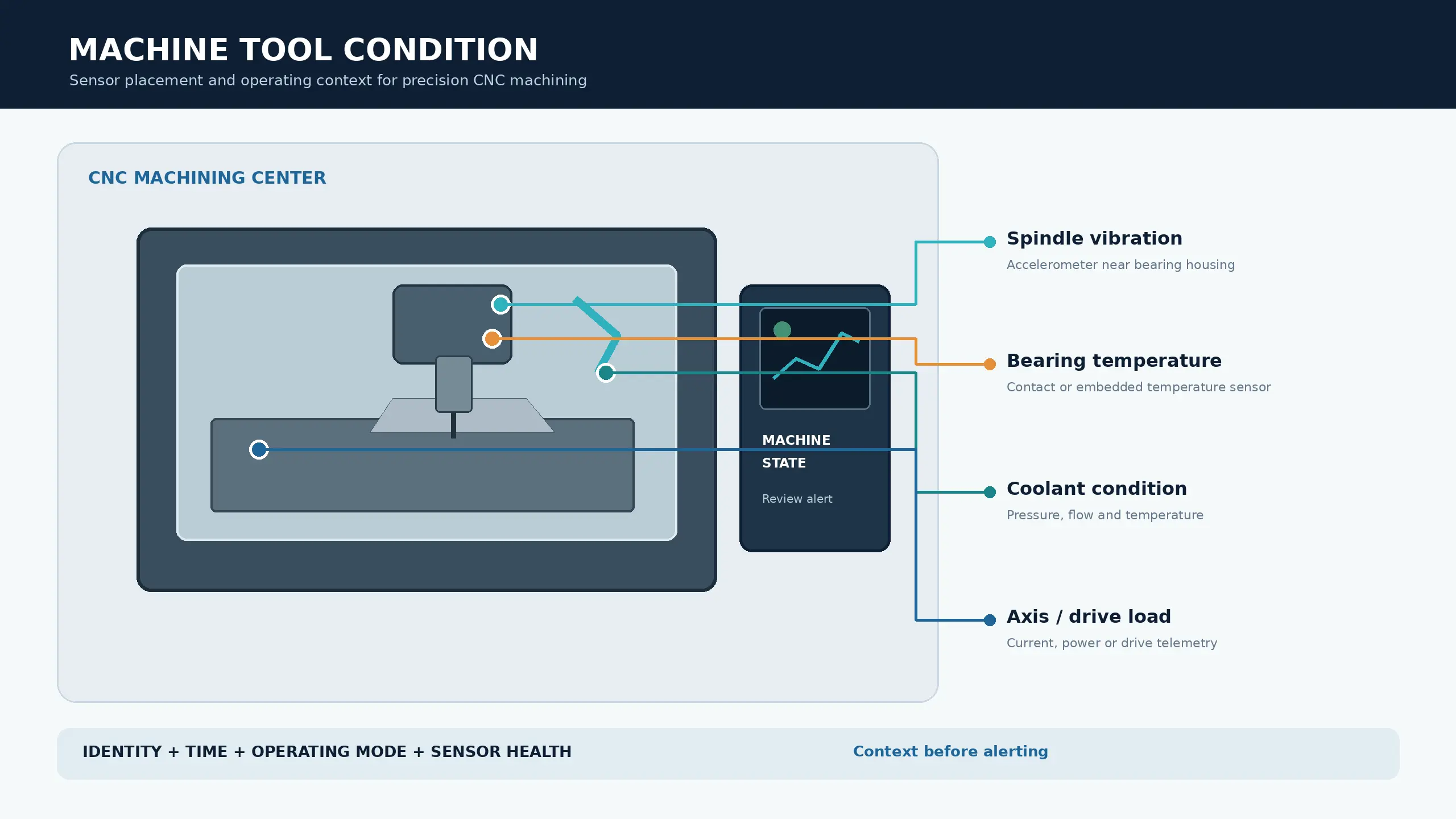
A rules-based check can identify readings that cross reviewed limits, while trend or anomaly analysis can highlight changes that merit closer inspection.
When an alert is raised, the maintenance or manufacturing engineering team reviews the machine state, recent operating history, sensor quality and relevant production records.
Possible Follow-Up Actions
- Physical inspection of the machine or relevant component.
- Repeat measurement to confirm the observed condition.
- Lubrication or coolant-system check.
- Tool-system or fixture review.
- Planned maintenance assessment.
Put Every Reading in Its Operating Context
A monitoring record should be associated with the correct machine or component, timestamp, unit, operating mode and sensor-health status. Where available, include spindle speed, feed rate, tool identifier, program or operation reference, machine state and production context.
These fields help distinguish a genuine change in equipment condition from an expected response to a different cut, tool, material or operating cycle.
Equipment Identity
Associate observations with the correct machine, component, sensor and relevant asset identifier.
Time and Operating Mode
Preserve timestamps and machine-state information so measurements can be interpreted in their production context.
Sensor Health and Calibration
Record sensor status, calibration information and missing or questionable measurements.
Preserve Raw Signals and Derived Features
The data pipeline should preserve the difference between raw signals and derived features. Raw vibration waveforms, for example, contain information that may be lost when data is reduced to a single average.
Derived measures such as root-mean-square vibration, peak amplitude, frequency-band energy or temperature rate of change can support analysis, but their calculation windows and assumptions should be documented.
Condition records can also be associated with maintenance events, tool changes, inspection findings and work orders when those records are available and approved for use.
Apply Thresholds and Anomaly Analysis Carefully
Reviewed Thresholds
Fixed thresholds can be effective when a variable has a well-understood operating limit and the measurement is reliable. Limits should be reviewed against machine documentation, process requirements and observed operating conditions.
Anomaly Detection
AI-supported analysis can assess patterns across multiple measurements or compare current behavior with a representative baseline. It may help identify gradual changes or combinations that are difficult to capture with one rule.
Engineering Review
Alerts should be evaluated with representative data, documented features and testing across normal production variation, startup, shutdown, tool changes and known disturbances.
When data are incomplete, stale, outside the evaluated operating range or inconsistent with sensor-health checks, the system should flag the limitation and route the result for review rather than present an unsupported conclusion.
Monitor Aerospace Composite Manufacturing Conditions
Composite manufacturing introduces process variables that differ from machine-tool condition measurements. During material preparation, layup, debulking, bagging and cure, process quality can depend on controlled temperature, pressure, vacuum, time and material-specific requirements.
The monitoring boundary should be defined for the selected process step and equipment, such as an autoclave, oven, vacuum-bag system or other approved cure arrangement.
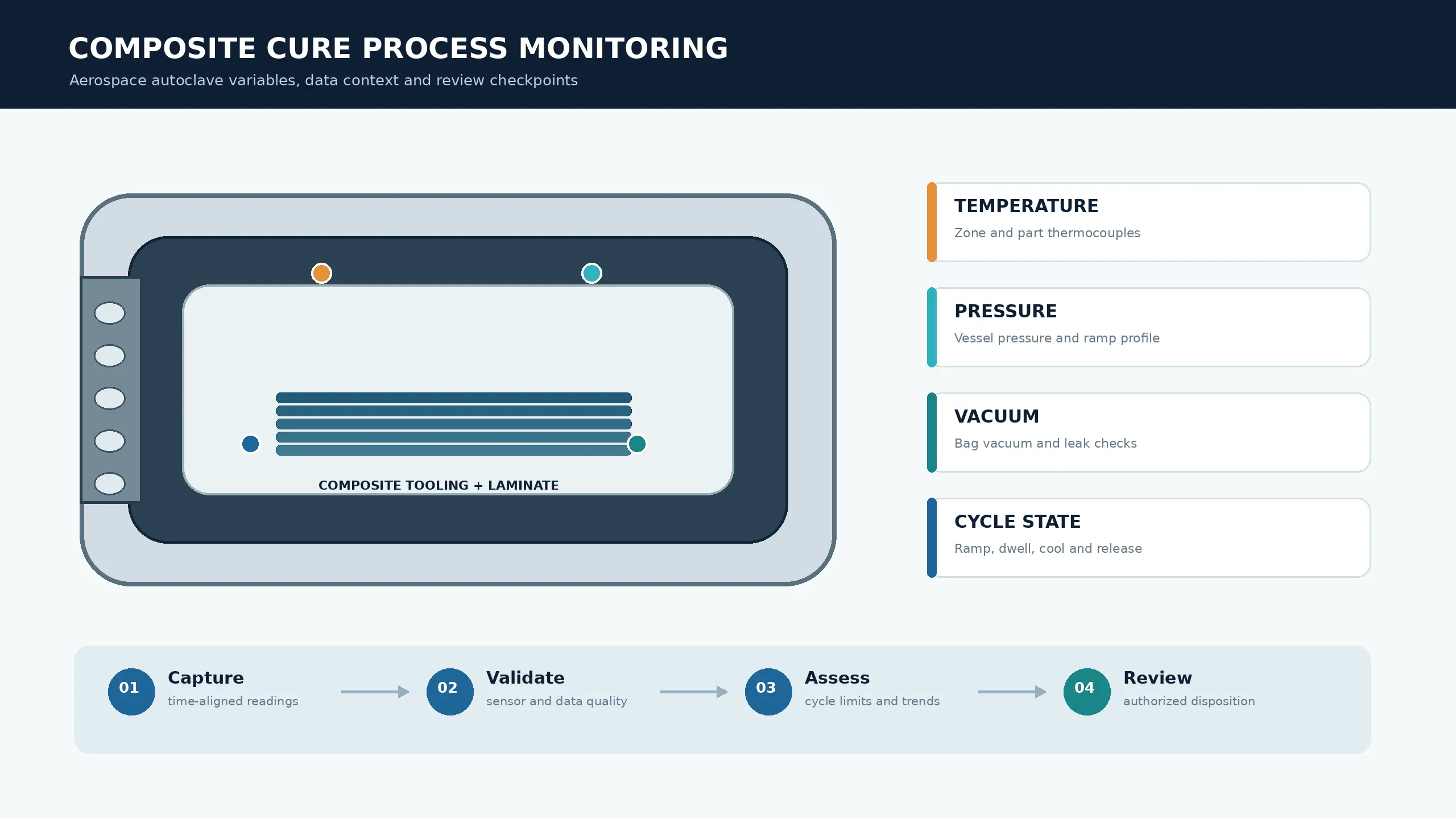
Autoclave Cure-Cycle Measurements
Temperature
Record temperatures at defined locations using suitable measurement points and approved engineering practice.
Pressure
Monitor vessel pressure and relevant pressure conditions associated with the selected process.
Vacuum
Observe vacuum level and relevant vacuum-system conditions during the defined process stages.
Ramp and Dwell Timing
Associate measurements with the cure-cycle state, including ramp, dwell and cooling behavior.
Material and Tool Identity
Associate readings with the batch or work order, material identity and tool identity.
Process Deviations
Preserve calibration status, missing-data flags, deviations and manual interventions for engineering review.
Review Deviations Against Approved Process Requirements
If a measured value moves outside an approved process window, the system can make the deviation visible to the responsible personnel and preserve the event for review.
Any decision to pause, adjust, continue or disposition a cycle remains subject to the facility's documented process authority and quality system.
Monitoring records help process engineers assess whether the observed cycle followed its approved requirements. They do not replace material qualification, non-destructive inspection or formal acceptance criteria.
Connect Physical Observations with Operational Decisions
A useful condition-monitoring workflow connects four stages. Each stage should preserve the information needed for the next review and make limitations visible.
Identify the Asset or Process
Associate every observation with a machine, component, tool, autoclave, batch or work order as appropriate.
Capture and Qualify Measurements
Record units, timestamps, sensor status, calibration information and missing or questionable readings.
Assess Condition
Apply reviewed limits, trend analysis or anomaly methods suited to the available data and operating context.
Route and Verify the Response
Send findings to the responsible engineering, maintenance or quality role. Record the review and confirm the result through a follow-up measurement or inspection.
Where a design includes an equipment command or process adjustment, it must specify the interface, authorization, operating limits, independent protective functions and confirmation of the resulting physical state.
Integrate with Existing Manufacturing Systems
Condition-monitoring data may need to exchange information with maintenance, production, enterprise and machine-level systems. The exact interfaces depend on the facility's equipment, system versions, network architecture, data ownership and security requirements.
CMMS
Computerized maintenance management systems for maintenance records, equipment history and work-order workflows.
MES
Manufacturing execution systems for production context, work orders and operation records.
ERP
Enterprise resource planning systems for relevant asset, material and production information.
Machine Controllers
Available machine data and operating-state information, subject to interface access and equipment constraints.
SCADA
Supervisory control and data acquisition environments where appropriate integration is available.
Edge and Server Systems
Data processing and communication components selected according to response-time, network and data-handling needs.
Define the Integration Requirements
- Asset identifiers and event timestamps.
- Measurement units, sampling and retention requirements.
- Data-quality flags and sensor-health information.
- User permissions, data ownership and audit records.
- Handling of offline devices and late-arriving messages.
- Handling of conflicting timestamps and invalid data.
No deployment model or third-party compatibility should be assumed before technical review. Edge processing may be appropriate where local response time, network availability or data-handling requirements call for it. Server or cloud components may be considered where permitted.
Evaluate Monitoring Before Expanding Deployment
A pilot should begin with a defined equipment or process boundary, a practical buyer question and a documented baseline. Select a manageable set of assets or one clearly bounded process, then confirm sensor suitability, installation constraints, data access, operating-mode coverage and the people responsible for reviewing alerts.
Evaluation should measure the quality and usefulness of the monitoring workflow, not just the number of readings collected.
| Evaluation Measure | What to Review | Purpose |
|---|---|---|
| Alert Usefulness | Proportion of reviewed alerts that lead to a meaningful inspection, maintenance or process follow-up. | Evaluates whether alerts support useful operational review. |
| Detection Delay | Elapsed time between a defined abnormal condition and the alert, measured only when reliable event timing is available. | Assesses the time required to make a defined condition visible. |
| False-Alert Rate | False alerts per operating hour or another explicitly defined exposure period. | Helps evaluate alert quality and unnecessary review effort. |
| Data Completeness | Share of expected observations received with valid timestamps, units and asset associations. | Measures whether the monitoring record is sufficiently complete. |
| Missing-Data Handling | How often gaps, stale readings or sensor faults are correctly identified and escalated. | Checks whether the system makes data limitations visible. |
| Calibration and Maintenance Effort | Labor and service required to keep sensors and acquisition equipment reliable. | Evaluates the ongoing effort required to maintain monitoring. |
| Follow-Up Verification | Whether an inspection, repeat measurement or process record confirms the condition that prompted the alert. | Connects monitoring output with an independently reviewed result. |
If a study uses synthetic data, label it as a simulation and do not present its outputs as customer results or field validation.
Start with a Specific Asset or Process Question
The most useful starting point is a specific question: which condition needs to be observed, what decision should the information support, and who is responsible for the response?
Machining and composite operations have different measurement requirements, failure mechanisms, quality constraints and acceptance processes. A monitoring design should reflect those differences instead of applying a generic sensor package across the factory.
Machentra can work with your team to define the equipment boundary, review available signals and records, identify integration dependencies and establish pilot evaluation criteria. The resulting scope should make clear which elements are proposed, which have been tested and what requires site-specific validation.
Related Machentra Resources
Discuss Your Condition Monitoring Requirements
Bring a target machine or process, the measurements already available, relevant maintenance or process records and the operational decision you want to improve. Machentra can use that information to help frame a practical condition-monitoring assessment for your precision machining or aerospace composites environment.
Contact Machentra