Integrating Physical AI and AIoT with Aerospace Manufacturing Systems
Reliable integration turns physical observations into usable operational records. In aerospace precision machining and composites manufacturing, that means connecting equipment, sensors, identification systems, and AI-supported decisions with the manufacturing and business systems that govern production, quality, maintenance, and material flow.
The integration design must define where each record originates, which system owns it, how assets and work orders are identified, when events are considered complete, and what happens when a message is delayed or rejected. Without those rules, a connected machine may generate useful data while the organization still lacks a dependable production record.
This guide uses a representative CNC machining event to explain the integration pattern. The example is illustrative. Actual interfaces, field names, identifiers, security controls, and acceptance criteria must be confirmed against the facility’s systems and approved procedures.
Beyond connectivity
Why Physical AI and AIoT Integration Requires More Than Connectivity
A sensor connection or an API endpoint does not, by itself, create an operational integration. A useful implementation links a physical observation to the correct machine, part, operation, work order, and production context. It also preserves the time and quality information needed to interpret that observation.
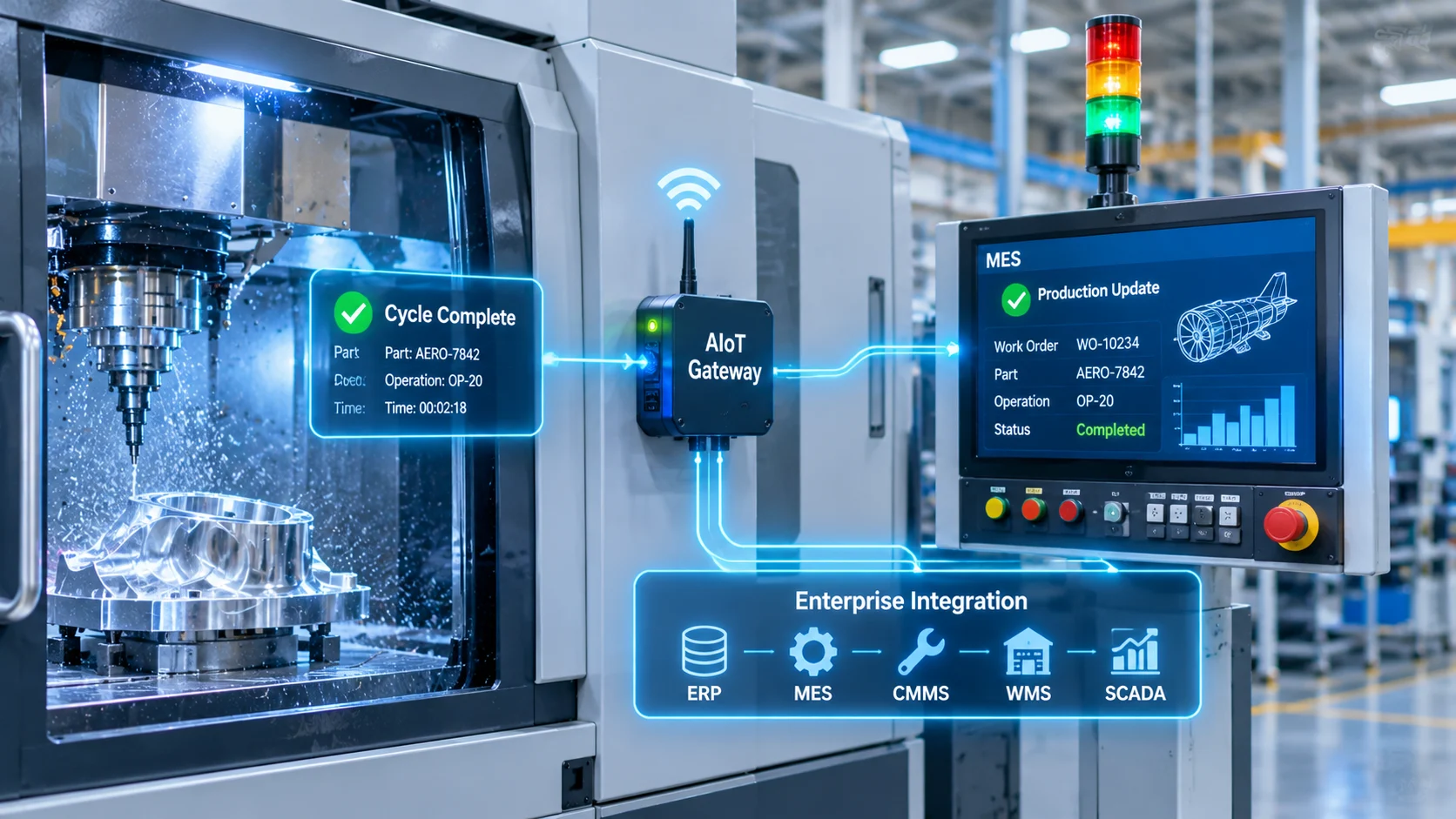
For a precision machining cell, the relevant sources may include a CNC controller, machine-state sensors, an RFID or barcode reader, an edge gateway, and an operator confirmation. Destinations may include a Manufacturing Execution System (MES), Enterprise Resource Planning (ERP) system, Computerized Maintenance Management System (CMMS), Warehouse Management System (WMS), or Supervisory Control and Data Acquisition (SCADA) environment.
The appropriate destination depends on the business purpose. The MES may own the production operation and its completion status. The ERP may own the production order and material accounting. The CMMS may own the maintenance work order. The integration layer should not silently replace those systems of record.
Worked example
CNC Machining Cycle Completion to the MES
Consider a CNC machining center producing a precision-machined aerospace component. The controller reports that a programmed cycle has completed. A machine-state signal and the current job context are collected by an edge gateway. The integration service associates the event with the machine, part, operation, and production order, then submits a completion event to the MES for validation.
The MES checks whether the referenced work order and operation are active, whether the machine is assigned to the operation, and whether the event is valid for the current production state. If the required checks pass, the MES records the event or places it into the appropriate review workflow. If a required identifier is missing or the operation is not open, the MES rejects or holds the record and returns a reason.
A cycle-complete signal is not proof that the part passed inspection or that the full operation is accepted. Dimensional inspection, operator sign-off, nonconformance disposition, and other quality requirements remain separate records and must follow the facility’s approved process.
Illustrative Event Record
The following values are fictional examples for explaining the data mapping. They are not customer data, Machentra deployment evidence, or approved identifiers.
Field
Example
Purpose
event_id
EVT-CNC-2026-004218
Unique event identifier used for traceability and duplicate detection.
event_type
machine_cycle_completed
Controlled event name describing the reported occurrence.
asset_id
ASSET-CNC-042
Stable identifier for the CNC machining center.
part_id
PART-AX-008731
Fictional part identifier associated with the operation.
work_order_id
WO-2026-01842
Production order reference owned by the relevant business system.
operation_id
OP-040
Operation sequence or routing step associated with the event.
event_time
2026-11-23T09:42:18-05:00
Time the machine event occurred, including the local UTC offset.
ingestion_time
2026-11-23T09:42:20-05:00
Time the integration service received the event.
cycle_count
1
Count or increment reported for this completed cycle.
data_quality
valid
Quality flag indicating whether required fields and source checks passed.
source_system
CNC_EDGE_GATEWAY_01
Originating system or adapter.
correlation_id
CORR-WO-2026-01842-OP040
Identifier used to follow related processing across systems.
The event contract should also define field types, required versus optional values, allowed units, time-zone handling, enumerated event names, maximum message size, schema version, and validation rules. If a measurement is included, its unit and quality flag must travel with the value. A numeric value without its unit or source context is not a reliable production record.
System roles
Mapping the Event to Industry Systems
A single physical event may support several downstream workflows, but each destination should receive only the information it needs. The integration design should identify the authoritative owner for each business object and define whether the receiving system creates, updates, or merely references the record.
System
Possible role in the CNC event workflow
Integration consideration
MES
Validates the active work order and operation, then records the machine event or routes it for review.
Provides production-order and material context; may receive approved production progress from the MES.
Avoid allowing a raw machine event to change inventory or order status without the ERP/MES business rules.
CMMS
Receives selected machine-health or fault events that may require maintenance review.
Do not convert every machine alarm into a maintenance work order. Apply approved thresholds and triage rules.
WMS
Uses approved material or component movement events when the workflow includes inventory transfer or staging.
Keep physical custody confirmation distinct from a machine-cycle event.
SCADA or machine monitoring
Provides equipment state and process context where applicable.
Define read/write boundaries and do not bypass validated controller or safety functions.
The integration map should also include the edge gateway, message broker or middleware, identity service, and monitoring tools where they are part of the proposed design. These components provide transport, translation, validation, and observability. They do not automatically become the owner of production, quality, or maintenance records.
Data contract
Define the Data Contract Before Building the Interface
A data contract is the agreed structure and meaning of the information exchanged between systems. It prevents the same field from being interpreted differently by a machine adapter, integration service, MES, and reporting application.
For Physical AI workflows, keep the observation, decision, command, and outcome as separate records. An observed machine state is not an AI decision. An AI decision is not an authorized command. A command acknowledgment is not proof that the requested physical state was achieved. Where a bounded action is part of the workflow, record the authorization, command ID, controller response, and independently observed outcome.
Interface pattern
Choose an Exchange Method That Fits the Workflow
The interface pattern should reflect the capabilities and constraints of the source and destination systems. Common options include vendor-supported APIs, industrial protocols, database or file exchange where approved, message brokers, and integration middleware. The correct choice depends on supported interfaces, network boundaries, response-time requirements, message volume, and the system owner’s operating rules.
Exchange pattern
Suitable use
Design checks
API request/response
Submitting a validated event or retrieving work-order context.
Authentication, authorization, schema validation, timeouts, rate limits, and response codes.
Message-based exchange
Delivering asynchronous events from gateways or integration services to subscribed applications.
Message identity, ordering expectations, acknowledgments, retention, retry policy, and dead-letter handling.
Industrial protocol or gateway adapter
Collecting equipment state or measurements from supported controllers and devices.
Read/write permissions, protocol compatibility, network segmentation, polling or subscription load, and controller-owner approval.
Scheduled file exchange
Controlled batch transfer where real-time exchange is not required or supported.
File naming, checksums, encryption, completeness checks, replay protection, and reconciliation.
Use vendor-supported interfaces and document any middleware or adapter dependency. Do not assume that every CNC controller, MES, ERP, or SCADA installation exposes the same fields or supports the same protocol. Confirm interface availability and licensing with the relevant system owners.
Data handling
Validation, Acknowledgment, and Synchronization
Distinguish received, accepted, rejected, and processed states.
Validation should occur at the boundary where data enters a receiving system. At minimum, check message structure, required fields, identifier references, timestamp format, allowed event type, and value constraints. Business validation should then confirm that the event is valid for the current work order, operation, asset assignment, and workflow state.
An acknowledgment should indicate what happened to the message. A transport-level acknowledgment may only mean that a message reached a service. It does not necessarily mean that the MES committed the production record.
Define the synchronization model for each data object. Some values may be read from a system of record; others may be published as events; some updates may require explicit approval. Avoid uncontrolled two-way synchronization that can create conflicting updates or circular message flows.
Resilience
Failure Cases and Recovery
Integration failures are normal design conditions, not exceptional afterthoughts. A robust workflow identifies what the source does, what the integration layer records, and what an operator or system owner must do when delivery or validation fails.
Failure case
Expected handling
Evidence to retain
Duplicate delivery
Detect the repeated event using a stable event ID or idempotency key. Process it once and return the prior result where appropriate.
Original event ID, duplicate detection result, timestamps, and receiving-system response.
Temporary destination outage
Retain the message in a controlled queue or durable buffer, retry under a defined policy, and alert the owner when limits are reached.
Queue age, retry count, outage window, and recovery status.
Delayed or out-of-order event
Preserve event time and ingestion time. Apply an agreed ordering or late-event policy instead of silently rewriting history.
Source timestamp, receive timestamp, sequence or correlation data, and disposition.
Rejected record
Return a machine-readable reason, route the item to a review queue, and provide a controlled correction or resubmission path.
Rejected payload reference, validation rule, reason code, reviewer, and resolution.
Identifier mismatch
Do not guess the asset or work order. Hold the event for master-data correction or authorized manual association.
Unmatched identifier, source, attempted mapping, and approval trail.
Partial synchronization
Compare source and destination records, identify missing or conflicting updates, and reconcile under assigned ownership.
Reconciliation report, affected records, owner, and closure evidence.
Idempotency in Plain Language
Idempotency means that processing the same event or command more than once does not create the same business effect repeatedly. If a network timeout causes a sender to retry a CNC cycle-complete event, the receiving service should recognize the event ID and avoid creating a second completion record. The retry may receive the original processing result, but it should not duplicate the production transaction.
Use stable event identifiers, a documented deduplication window, and durable processing records. Do not rely only on matching timestamps or values, because two legitimate events can occur close together and have similar measurements.
Governance
Security, Ownership, and Auditability
Integration crosses operational and information-system boundaries. Define the permitted data flows, system identities, user roles, and administrative responsibilities before connecting production equipment to enterprise applications.
A software permission check is not a substitute for validated machine safeguards. Any workflow that can influence equipment must retain the required controller logic, interlocks, emergency-stop functions, and authorized human oversight. The integration layer must not bypass approved safety or quality controls.
Before go-live
Implementation Test Checklist
Before production acceptance, test the complete event path under representative operating conditions. Include both normal transactions and failure scenarios.
Acceptance Measures
Agree on measures before the pilot or production release. Useful measures include event completeness, valid association rate, end-to-end delivery delay, rejected-record rate, duplicate-processing rate, time to recover from an outage, reconciliation backlog, and the percentage of exceptions resolved within the agreed service window. Establish baselines and acceptance thresholds with the facility rather than publishing universal targets.
For workflows that include AI-supported decisions or physical actions, evaluate decision quality and verified physical outcomes separately from message-delivery performance. A successful integration test does not, by itself, establish that an AI model is accurate or that an equipment action is safe.
Confirm source and destination system owners, data ownership, and approved interface specifications.
Verify asset, part, work-order, and operation identifiers against controlled master data.
Check event types, required fields, units, timestamp format, time-zone handling, and schema version.
Test valid events, missing fields, invalid identifiers, out-of-range values, and rejected records.
Test duplicate delivery, retry behavior, delayed events, out-of-order messages, and destination outages.
Confirm that acknowledgments distinguish receipt from business acceptance and processing.
Verify that buffering, recovery, replay, and reconciliation do not create duplicate business records.
Review service identities, least-privilege access, encryption, network segmentation, and audit logging.
Confirm that physical-action interfaces, if any, remain within approved authorization and safety boundaries.
Assign operational owners for monitoring, exceptions, manual correction, incident response, and periodic review.
Obtain business acceptance from manufacturing, quality, maintenance, IT/OT, cybersecurity, and system owners as applicable.
FAQ
Common Integration Questions
Does connecting a CNC machine to an MES make it a Physical AI system?
No. Connectivity can provide machine observations to operational software. Physical AI additionally involves AI-supported decisions and, where applicable, an authorized action path with appropriate controls and verification.
Should the MES, ERP, or integration platform own the production event?
The system of record should be assigned according to the organization’s process and application responsibilities. The integration platform transports and transforms information; it should not silently become the owner of production, quality, or inventory records.
What is the difference between event time and ingestion time?
Event time records when the physical or operational event occurred. Ingestion time records when the receiving integration service obtained the message. Keeping both helps teams identify network delays, clock differences, and late-arriving events.
How should duplicate messages be handled?
Use a stable event identifier or idempotency key so a repeated delivery does not create a second business transaction. Keep the processing result and return it when the same event is received again.
Can an AI decision directly change a CNC program or machine setting?
That depends on the approved system design, equipment interface, validation, permissions, and operating safeguards. An AI recommendation should not be treated as an authorized controller command. Any physical action requires defined authority, operating limits, fault handling, and verification.
What should happen when the MES is unavailable?
The design should specify whether the source can buffer events, how long data can be retained, which operations may continue, who is notified, and how records are reconciled after service returns. The correct behavior must be approved for the facility’s production and quality procedures.