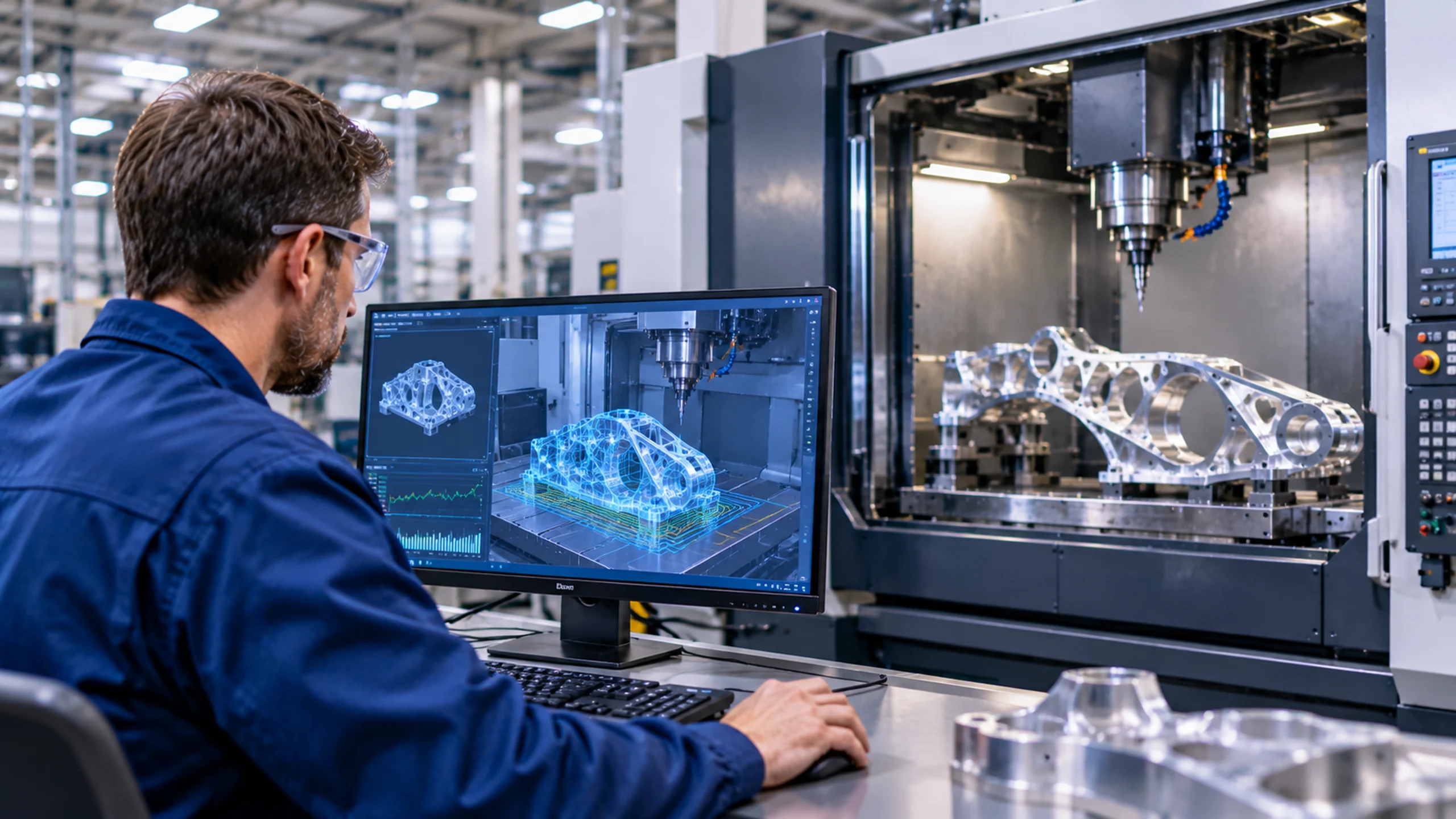
Research directionModel Manufacturing Conditions Before Physical Execution
A model can support engineering decisions only when its process boundary, assumptions, uncertainty, and validation evidence are understood.
Simulation can help aerospace manufacturers examine operational choices before physical execution. A machining or composite process model can represent equipment, workpieces, material properties, process constraints, and production events, allowing engineers to compare possible operating conditions without immediately changing a live production system. The value of the model depends on how well it represents the physical process, how its assumptions are documented, and whether its predictions are checked against relevant observations.
Machentra’s research direction examines how industrial digital twins, process simulation, and data-driven world models could support precision machining and composite manufacturing. The focus is on operational questions: estimating the current state of a machine or workpiece, predicting the likely consequences of a proposed action, testing unusual conditions, and understanding where simulated behavior may differ from the factory floor.
Relevant settings include multi-axis CNC machining of aluminum and titanium structures, precision boring and milling, tool and fixture changes, in-process probing, dimensional inspection, composite ply placement, vacuum-bag preparation, autoclave or out-of-autoclave cure, and movement between production and metrology areas.