Aerospace engineer reviews a CNC machining digital twin beside a precision-machined component.
Research / R06

Industrial Digital Twins and Simulation Research for Aerospace Manufacturing

Explore operational digital twins, process simulation, state estimation, candidate-action evaluation, synthetic data, and the limits of simulation-to-reality transfer for precision machining and composites.

Discuss a simulation research question
Research direction

Model Manufacturing Conditions Before Physical Execution

A model can support engineering decisions only when its process boundary, assumptions, uncertainty, and validation evidence are understood.

Simulation can help aerospace manufacturers examine operational choices before physical execution. A machining or composite process model can represent equipment, workpieces, material properties, process constraints, and production events, allowing engineers to compare possible operating conditions without immediately changing a live production system. The value of the model depends on how well it represents the physical process, how its assumptions are documented, and whether its predictions are checked against relevant observations.

Machentra’s research direction examines how industrial digital twins, process simulation, and data-driven world models could support precision machining and composite manufacturing. The focus is on operational questions: estimating the current state of a machine or workpiece, predicting the likely consequences of a proposed action, testing unusual conditions, and understanding where simulated behavior may differ from the factory floor.

Relevant settings include multi-axis CNC machining of aluminum and titanium structures, precision boring and milling, tool and fixture changes, in-process probing, dimensional inspection, composite ply placement, vacuum-bag preparation, autoclave or out-of-autoclave cure, and movement between production and metrology areas.
Manufacturing context

Why Digital Twins and Simulation Matter

Aerospace manufacturing combines high-value materials, tightly controlled process plans, complex geometries, long production routes, and demanding inspection requirements. A process change can influence several downstream outcomes at once.

01 / PROCESS INTERACTIONS

Compare More Than Cycle Time

Changes to spindle speed, feed rate, tool condition, fixture strategy, cure schedule, or sequence can influence cycle time, dimensional stability, surface condition, material utilization, equipment loading, rework exposure, and downstream inspection.

02 / PARTIAL OBSERVABILITY

Make Data Gaps Explicit

CNC controller data may not capture workpiece temperature or fixture behavior. Cure records may not describe every local material condition. MES events may omit transient process behavior. Simulation can explore these gaps without treating modeled assumptions as measured facts.

Digital twin terminology: In this research, a digital twin is a digital representation connected to observations from a defined physical asset, process, or production system. Synchronization, calibration, and validation must be stated. An assumption-driven simulator should not be described as a validated twin of a specific machine or line.

Operational digital twins

State Estimation for Machines, Workpieces, and Processes

The research question is not simply whether a model can display a machine or component in three dimensions. It is whether it can estimate a decision-relevant state with known uncertainty and sufficient accuracy for the intended use.

Machining State Variables

Spindle and axis operating conditions, tool engagement, tool-wear indicators, machine thermal state, fixture configuration, workpiece temperature, remaining stock, operation progress, and in-process inspection status.

Composite State Variables

Material batch and out-time, ply sequence, layup progress, vacuum integrity, cure temperature and pressure history, equipment state, and inspection findings.

Potential methods include physics-based process models, reduced-order models, discrete-event simulation, statistical state estimation, and hybrid approaches that combine engineering relationships with observed data. The method depends on the physical process, measurements, update frequency, model complexity, and consequences of an incorrect estimate.

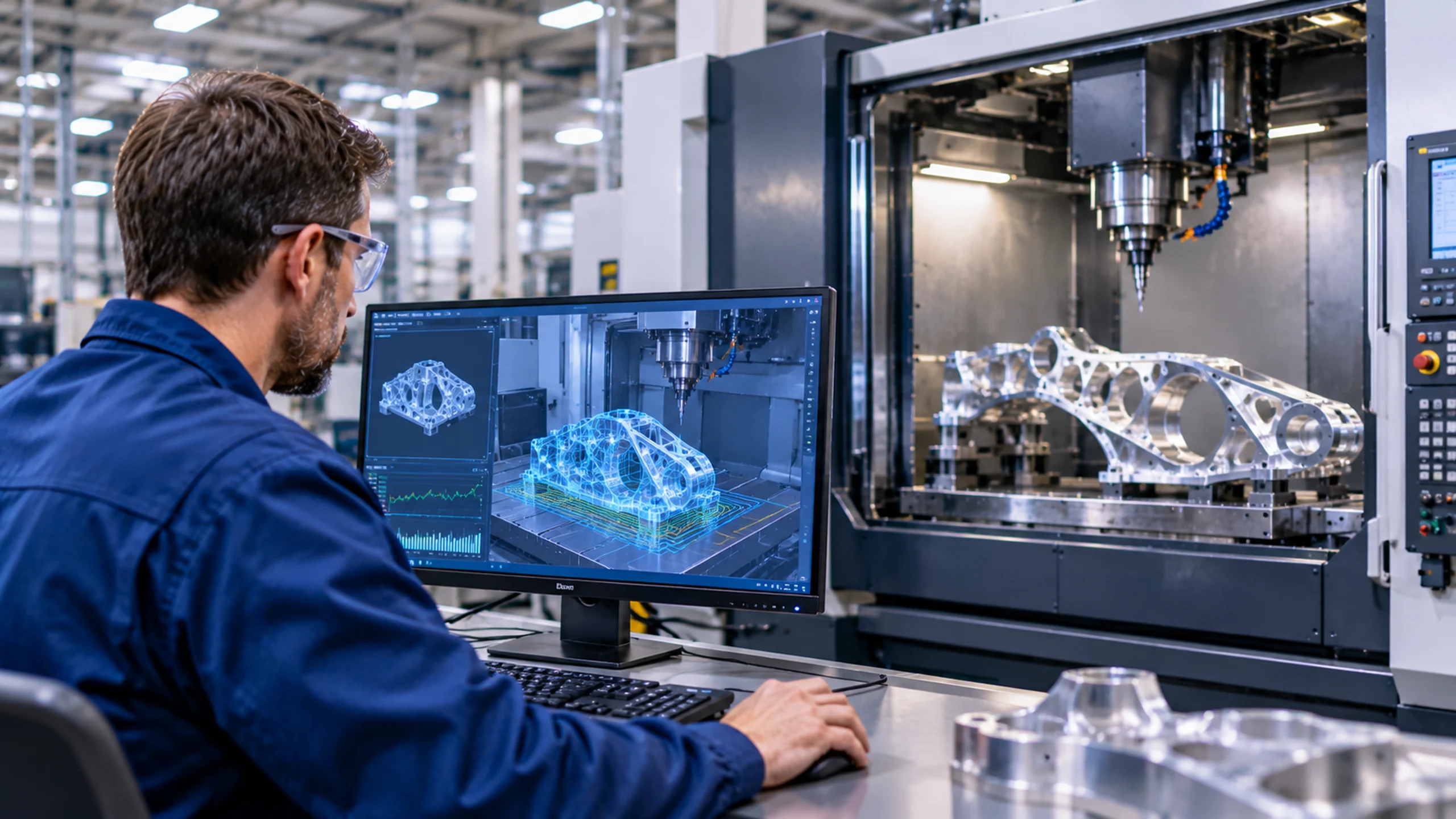
Aerospace engineer reviews a CNC machining digital twin beside a precision-machined component.
Aerospace CNC Machining Digital Twin and Process Simulation. Illustrative scene showing a physical machining context and a virtual model used to review machine state, toolpaths, and candidate operating conditions. AI-generated illustrative image; not a stock photograph, verified Machentra installation, or evidence of a deployed digital twin.
Research questions

What Should the Model Represent?

  • Which machine, process, workpiece, tooling, and material variables are necessary to estimate the selected operation’s state?
  • How should CNC, PLC, temperature, vibration, probing, MES, QMS, tool-management, and metrology observations be time-aligned and associated with the correct part and operation?
  • How can uncertainty from missing readings, delayed inspection, tool geometry changes, fixture variation, material variability, or incomplete records be represented?
  • Which physical relationships should be modeled explicitly, and which variables can be estimated from historical or streaming data?
  • How frequently should a model update for the intended decision, and what compute and communications resources are required?
Decision support

Compare Candidate Actions Before Execution

A useful operational model should support comparison of candidate actions, not just visualization of current conditions. Engineers could compare toolpaths, cutting parameters, operation sequences, fixture strategies, machine assignments, or maintenance windows against defined constraints.

Composite process studies could compare approved cure profiles, equipment loading plans, or sequence alternatives within the applicable process specification. An industrial world model may estimate downstream effects such as queue growth, machine utilization, tool-life consumption, dimensional variation, energy demand, or inspection-hold probability.

Candidate actions should be evaluated against explicit objectives and hard constraints. A faster simulated cycle is not automatically acceptable if it violates an approved process window, tool or machine limits, quality requirements, material restrictions, or safety procedures. Simulation should inform engineering review rather than bypass approvals.

Simulation-to-reality limits

Synthetic Data, Transfer, and Model Mismatch

Synthetic data can broaden development and test coverage by generating normal, rare, and degraded conditions that are difficult, costly, or unsafe to reproduce on production equipment.

Scenario Generation

Simulated machine loads, tool conditions, workpiece geometries, process variations, production schedules, and equipment faults can be used to test method behavior across a wider range of conditions.

Transfer Degradation

Model gaps may arise from vibration, thermal drift, cutting-fluid behavior, tool wear, machine compliance, material anisotropy, sensor placement, operator intervention, or as-built equipment differences.

Synthetic observations are not equivalent to physical measurements. Studies should document model fidelity and parameter distributions, then evaluate transfer degradation against held-out physical observations where available. Without physical observations, outputs must be labeled assumption-based and plausibility-reviewed, with physical validation pending.

Counterfactual experiments

Explore Alternative Process and Production Conditions

Counterfactual simulation asks what might have happened under a different set of conditions. A study could compare alternative machine assignments, planned tool changes, revised sequences, or inspection handoffs.

Discrete-Event Production Models

Represent work orders, queues, machine availability, setup time, inspection capacity, material movement, and rework loops to explore production-flow interactions.

Physical Process Models

Represent selected behavior such as cutting forces, thermal effects, tool engagement, or cure-cycle response. Combined models can explore interactions between process behavior and production flow.

A counterfactual result is a model-based estimate, not proof that the alternative would produce the same outcome on a live facility. Document inputs changed, conditions held constant, uncertainty treatment, and any physical or historical evidence used for checks.

Controlled test environments

Hardware-in-the-Loop and Scenario Coverage

Hardware-in-the-loop (HIL) testing connects simulation to selected physical control hardware or representative equipment interfaces. It can reveal timing, interface, state-transition, and fault-handling issues that software-only simulation may not expose.

A controlled simulation may exchange signals with a CNC interface, PLC, robot controller, sensor gateway, or supervisory control component. The test boundary must identify versions, signal mappings, timing assumptions, interlocks, simulated components, and physical components included.

Tests should cover normal operating conditions, expected variation, rare events, and degraded conditions—such as delayed or missing sensor updates, tool-condition changes, machine alarms, network interruption, unexpected queue growth, incomplete inspection records, and recovery behavior after stale or invalid inputs.

Safety note: Any testing involving actual machine motion or energy must follow facility-approved machine-safety and test procedures. A controller connected to a simulated machine is not equivalent to a complete production cell.

Research inputs and platform

Data, Methods, and Model Lifecycle Requirements

Each study should begin with a named manufacturing problem, decision user, model boundary, and baseline. Data requirements should follow the selected process rather than convenient signal availability.

01

Physical Asset and Process Context

Controlled identifiers for machine, controller, spindle, axis, tool, fixture, part number, engineering revision, material lot, operation, work order, and inspection event.

02

Machine and Process Observations

CNC/PLC signals, spindle load, axis position, feed rate, vibration, acoustic measurements, temperature, tool offsets, alarms, probing results, and cycle-state events.

03

Composite Process Observations

Material batch, storage and out-time records, ply and layup sequence, tool identity, vacuum measurements, cure temperature and pressure history, and inspection findings.

04

Quality and Metrology Evidence

CMM results, laser tracker or optical measurements, surface inspection, NDT findings, dimensional reports, nonconformance records, and disposition status.

05

Model Inputs and Provenance

CAD/CAM revisions, toolpath versions, material properties, machine configuration, fixture definitions, boundary conditions, solver settings, parameter files, random seeds, and calibration records.

06

Data Quality and Synchronization

Source timestamps and time zones, sampling rates, cycle phase, calibration, missing intervals, unit conversions, delays, duplicate events, and measurement uncertainty.

07

Platform and Model Lifecycle

Assess edge, plant-server, and cloud execution for latency, compute, connectivity, cybersecurity, data residency, IP controls, and engineering review. Retain code, configurations, dataset and model versions, validation checks, sensitivity results, and reproducible run records.

For customer or controlled production records, review access, retention, confidentiality, export restrictions, and disclosure risk before reuse. Synthetic data derived from private records may still disclose sensitive process or production information.

Evidence-led evaluation

Demonstration Design and Evaluation

A proposed demonstration should build an operational simulation for one bounded aerospace machining or composite workflow. Generate normal, rare, and degraded conditions, then evaluate candidate actions within the model. Where physical observations exist, compare predictions with held-out measurements not used for calibration.

Where physical observations are unavailable, results must be labeled assumption-based and plausibility-reviewed, with physical validation pending. Passing simulation does not establish HIL, controlled equipment testing, or production readiness.

  1. State-estimation error: difference between estimated and independently measured machine, workpiece, material, or process state.
  2. Outcome-prediction error: difference between predicted and observed outcomes, reported by condition and operating range.
  3. Model mismatch: residual error and systematic differences between simulated behavior and physical observations.
  4. Scenario coverage: proportion and diversity of defined normal, rare, and degraded conditions represented.
  5. Simulation-to-reality transfer degradation: change in prediction or decision performance from simulated data to held-out physical observations.
  6. Decision usefulness: whether simulation changes a defined engineering decision, improves constraint visibility, or helps reject an unsuitable candidate.
  7. Compute cost and reproducibility: runtime, memory, hardware, update latency, scenario cost, and ability to reproduce runs from retained code, data, parameters, seeds, and solver settings.
Evidence boundary

Current Research Status and Limitations

This page describes a research direction and an evaluation framework for aerospace precision machining and composites. It does not claim that Machentra has deployed a calibrated digital twin at a customer facility, completed a specific HIL program, validated a production world model, or achieved quantified improvements in cycle time, yield, quality, or equipment utilization.

A model should be called a digital twin of a specific physical system only when its connection to that system, calibration basis, update behavior, validation evidence, and known limitations are documented. Simulation cannot replace engineering approval, process qualification, machine safeguarding, inspection, or applicable aerospace quality controls.

Candidate actions affecting machine motion, tooling, material processing, or product acceptance require appropriate engineering, quality, and operational authorization.

Start with a defined question

Discuss an Aerospace Manufacturing Simulation

Explore how simulation and operational digital twins could address a defined aerospace manufacturing question. Share the process boundary, available data, validation requirements, and the decision your team needs to examine.

Discuss a suitable research scope and evaluation plan with Machentra.

Contact Machentra
Scroll to Top